News
better business decisions
Posted 5 months ago | 5 minute read

Q&A: How integrated management and market participation create value for BESS assets
Battery energy storage systems (BESS) are now cornerstone assets within power systems. But as technology has scaled, so too has the complexity of managing it.
Projects must simultaneously capture multi-stack revenues while maintaining strict availability and warranty compliance. But increasing price volatility, variability in spreads, and complex regulations have exposed the performance gap between basic Energy Management Systems (EMS) and fully integrated optimization platforms.
Here we spoke to GridBeyond Senior Trader (USA), Ali Karimian to discuss the benefits of having a single-vendor for everything from project design through to market participation and why the real opportunity lies not just in deploying storage but in unifying design, control, forecasting, degradation modelling and trading execution into one continuous value chain.
Q: Why are integrated platforms becoming more important in the BESS market?
With the fall of the BESS revenues due to the massive installation of batteries in the past few years in most ISOs, owners are no longer simply charging and discharging batteries. Projects require forecasting, market optimization, degradation modeling, and direct market participation in addition to operational control. Without these integrated capabilities, operators can struggle to react quickly to changing market conditions or fully optimize asset performance. An integrated platform brings these functions together into one ecosystem.
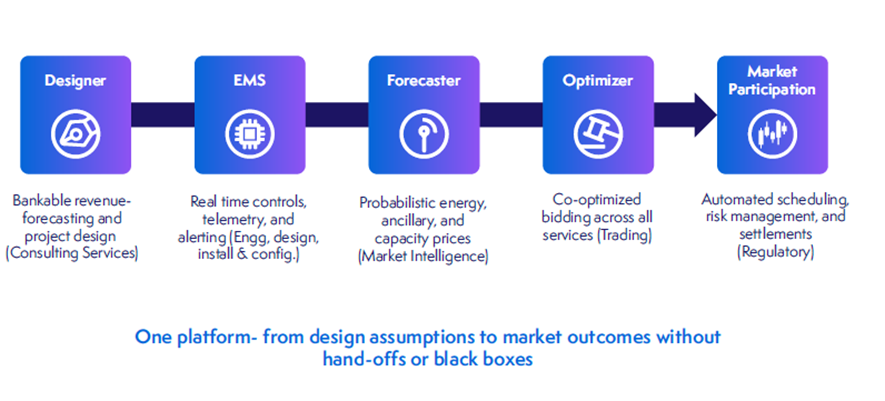
Instead of using disconnected systems for forecasting, optimization, trading, controls, and wholesale market participation, operators can manage the entire asset lifecycle through a single platform. This improves co-ordination, reduces delays, and creates a clearer path to maximizing long-term value.
Q: How does project design influence long-term value?
A stochastic modeling of the project valuation gives the project owners and underwriters a view of various scenarios unfolding in the market under different conditions. For example how load growth, installation of solar or wind generation, or gas prices would impact the value of a stand-alone or collocated BESS project would be studies in this framework. This comprehensive study will not only give a more clear project of the expected value of the project, but also helps to think about hedging the value in different scenarios.
Q: How does the EMS support complex energy assets?
The EMS is installed directly on site and can work alongside other EMS systems when required. This flexibility is increasingly important as many projects now combine multiple technologies.
A virtual power plant may include battery storage, solar generation, gas generation, and site load all operating together. The EMS can orchestrate these assets within a single operational framework while remaining customizable to each project’s requirements. This creates a more flexible and scalable operating model for increasingly complex energy portfolios.
Q: What role does forecasting play in optimization?
Forecasting is critical for understanding future market opportunities and operational conditions. The forecasting layer analyzes market and asset data to improve visibility of expected performance and price movements. Better forecasting supports more informed dispatch decisions, more effective trading strategies, and improved revenue capture across different market opportunities.
Q: What is the optimizer responsible for?
The optimizer manages the trading and market optimization process. It determines how the asset should participate in different markets to maximize value while respecting operational constraints and battery health considerations. By linking forecasting, operational control, and market participation together, the optimizer helps improve both commercial returns and operational efficiency.
Q: Why is market participation with GridBeyond such an advantage?
GridBeyond engages with the ISO in real time. This becomes particularly important during dispatch or clearing issues. Because the market unit is held directly, the trading team can communicate directly with the relevant ISO desk to resolve issues faster.
Some competing optimization providers may support dispatch strategies but lack direct market participation capabilities. Without that direct connection, issue resolution can become slower and more complex.
Q: How does risk management fit into the platform approach?
Risk management is becoming increasingly important as storage assets participate in more volatile and competitive markets. The GridBeyond trading team supports customers with hedging strategies for both generation and load portfolios. This includes pricing analytics, scenario analysis, and risk modeling to evaluate potential payoffs under different market conditions. The goal is not simply to maximize short term revenue, but to create a strategy that protects long-term asset value while managing downside exposure.
Q: What is the long-term opportunity for BESS operators?
Future opportunities lie in unifying every stage of the asset lifecycle into one continuous value chain. The industry is moving beyond standalone forecasting tools and towards fully integrated energy platforms that combine project evaluation, operational control, forecasting prices, degradation modeling, optimization of the bids and offers, trading market participation in the wholesale energy markets, and risk management. As energy markets become more dynamic, the ability to connect all of these functions together will increasingly determine which assets deliver the strongest long term performance.
Direct access to all parts of the hardware and software stack is also crucial as it allows for problems to be identified and resolved faster. In highly volatile energy markets, time matters. When multiple vendors are involved, operators may need to spend hours identifying where a problem originated. During that time, assets may miss market opportunities or remain unavailable.
A single integrated provider creates one point of accountability. Rather than coordinating across several counterparties, operators can resolve issues faster and with greater confidence.