News
better business decisions
Posted 2 months ago | 5 minute read
Winter hits Texas: what that means for ERCOT, prices and your power strategy
After weeks of mild conditions, incoming Arctic air is set to bring freezing temperatures over the weekend into early next week. In this article we explore the impacts of weather events on power markets.
ERCOT Weather Watch: Jan 24-27
On January 21, 2026, ERCOT issued a Weather Watch for January 24-27, citing forecasted below-freezing temperatures with the possibility of frozen precipitation, higher electrical demand, and lower operating reserves.
Here’s what that means:
- Grid conditions are expected to remain normal throughout the Weather Watch period. No energy emergency is forecast at this time
- ERCOT is monitoring conditions closely and deploying all available tools to manage the grid with a reliability-first approach
- Texans are encouraged to sign up for grid condition alerts via the Texas Advisory and Notification System (TXANS) and follow real-time dashboards on supply and demand
Despite some public anxiety stemming from the widespread outages of 2021, ERCOT has stated that power supply should be sufficient to meet demand even as temperatures drop.
Volatility and opportunities
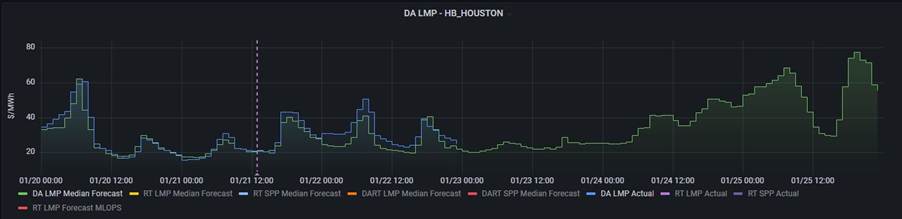
Unlike summer heat waves, which tend to build slowly and predictably, winter events often arrive abruptly. Load rises, supply assumptions are questioned, and price formation becomes as much about uncertainty as it is about fundamentals. In the early stages of the cold weather, that dynamic has been clearly visible. Prices have responded not only to forecast demand but to the possibility of reliability issues.
Source: GridBeyond
From a short-term perspective, these conditions favour flexibility. When temperatures fall, heating load increases sharply during morning and evening hours, precisely when solar output is limited. The resulting mismatch between supply and demand creates brief but intense price signals, particularly in real-time and day-ahead markets. Batteries, fast-ramping thermal assets, and flexible demand are uniquely positioned to respond to these signals. In many cases, it only takes a handful of well-timed dispatch intervals to materially change the revenue profile of an asset over the course of a week.
In volatile conditions, forecasting accuracy becomes a competitive advantage. Where price excursions can be sudden and sharp, confidence in forecasts can be the difference between capturing volatility and merely observing it.
But the more valuable opportunities often emerge beyond the prompt market. Extreme weather events routinely distort forward prices. During and immediately after cold snaps, forward curves tend to reflect heightened risk aversion rather than fundamentals. Risk premiums widen, liquidity thins, and prices can temporarily decouple from average conditions. These dislocations are rarely permanent, but they don’t need to be. Even a short window of elevated forward pricing can offer asset owners a chance to materially improve revenue certainty. The goal is not to hedge at the first sign of volatility, nor to chase upside indiscriminately. The real question is which risks are worth it. Asset owners must balance the upside potential of remaining open to price spikes against the very real financial and operational consequences of adverse outcomes.
For organisations with trading desks, that balance is constantly recalibrated. For leaner teams, it’s far more challenging. Evaluating fair value, understanding whether forward prices truly compensate for retained risk, and executing hedges efficiently in a fast-moving market requires time, tools, and experience, all at a time when weather events are compressing decision timelines.
ERCOT itself has been clear that grid conditions are expected to remain normal this week. From a reliability standpoint, that message is reassuring. But from a market standpoint volatility does not require an emergency to materialise. Equally, once uncertainty fades, whether because the weather moderates or confidence returns, opportunities close quickly. This is why periods like this matter. They sit at the intersection of weather, risk-based decision-making, and market structure.
Conclusion
Texas is gearing up for a classic winter event. While the grid is expected to handle the increased demand, cold weather always introduces additional pressure points and markets will reflect that through price volatility and hedging behaviour. At moments like this, execution matters as much as insight. Volatile conditions reward those who can act decisively, but only when decisions are grounded in a clear, credible view of the market.
This is where GridBeyond’s forecasting capability has proven its value. Our ERCOT day-ahead price forecasts have tracked realised outcomes with exceptional accuracy, providing asset owners with the confidence to commit earlier and optimise better. The Houston Hub has been a particularly strong example, where forecast signals aligned closely with actual price formation even as weather uncertainty intensified. In environments where timing is everything, that level of forecast fidelity can materially change commercial outcomes.
But forecasting is only half the equation. Volatility inevitably raises the question of risk: how much to retain, how much to hedge, and at what price. Many asset owners operate with lean teams, without a dedicated trading, or origination desk to continuously assess value or structure hedges as markets move. In those cases, the challenge is not identifying opportunity but acting on it. GridBeyond works alongside asset owners to bridge that gap. We help define which risks make sense to take, assess forward pricing against asset-specific fundamentals, and translate market volatility into structured, executable strategies.
In fast-moving ERCOT conditions, the advantage rarely comes from reacting faster than everyone else. It comes from being prepared before volatility, with the data, the insight, and the support needed to act when the window opens.