News
better business decisions
Posted 1 week ago | 3 minute read

Data center power demand driving fossil generation, says EIA
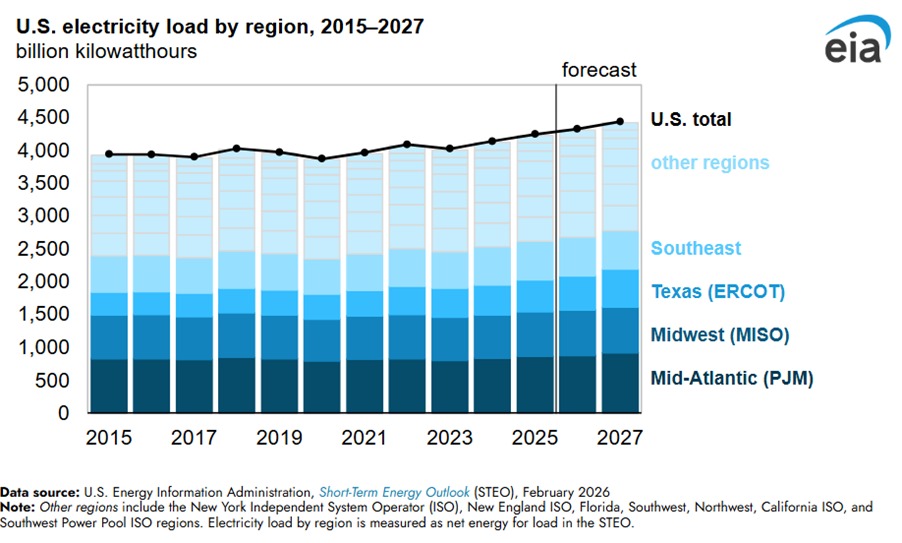
Between 2020 and 2025, US electricity demand grew about 1.7% annually compared with 0.1% annual growth between 2005 and 2019. But demand has been rising steadily since 2020, driven by data center growth, the U.S. Energy Information Administration (EIA)’s Short-Term Energy Outlook (STEO) has found.
Published on March 12, the report notes that development of large computing facilities and growth from expanded industrial use of electricity are likely to continue driving growth in US electricity demand in the near term. It forecasts that electricity load will increase by 1.9% in 2026 and 2.5% in 2027, with the highest load growth will be in the ERCOT and PJM regions where forecast growth of annual electricity load averages 10% and 3%, respectively, between 2025 and 2027. Midcontinent Independent System Operator (MISO) and the Southwest Power Pool (SPP), will also likely experience high growth in power demand from data centers. But the EIA forecasts that these regions will experience relatively low load growth overall because of low electricity demand growth from households and other sectors.
Source: EIA
The higher electricity demand would primarily be met from increased utilization of natural gas-fired power plants, which accounted for 40% of total generation in 2025 and could increase by 1.7% between 2025 and 2027. Under the higher electricity demand scenario, the two-year increase would rise to 7.3%. Generation from coal accounted for 17% of total generation in 2025. Generation from intermittent sources (wind and solar) is dispatched as the resource is available and, combined, accounted for 18% of total generation in 2025.
Higher electricity demand would likely result in higher average wholesale electricity prices. The effect of higher demand would be most pronounced in ERCOT where the 2027 wholesale price is forecast to be $37/MWh.
Cost vs volatility
Electricity is not a marginal cost for many sectors. For manufacturers, food processors, cold‑storage operators, pharmaceuticals, data centers, and other energy‑intensive businesses, power can represent a major share of operating expenditure. But high cost is not the only issue, volatility is equally challenging.
This is where intelligent energy optimization technologies come in. Rather than passively absorbing price shocks, businesses can start to shape their demand in response to real‑time price signals and operational constraints.
Solutions like TwinPoint from GridBeyond are built specifically for this environment. TwinPoint is an AI‑driven energy optimization platform designed to help businesses anticipate and respond to electricity price movements in real time. Instead of treating energy as a static cost, it brings together:
- forecasting and predictive analytics to anticipate price spikes before they occur, using market data, weather forecasts, and system conditions
- operational modelling and digital twins to understand and analyze which processes can be shifted, slowed, or accelerated without harming output or quality
- optimization of on‑site assets such as battery storage, CHP units, backup generation, and flexible loads like refrigeration, pumping, or certain production lines
By combining these capabilities, TwinPoint can shift energy‑intensive processes to lower‑cost periods, discharge storage or reduce flexible loads during peak price events, cutting exposure to extreme spikes and coordinate participation in demand‑response or flexibility markets, turning flexibility into a revenue stream rather than just a cost‑saving measure. The result is that volatility becomes something businesses can plan around rather than simply absorb.
Latest energy insights
-
 Press Release
26 March 2026
3 minute read
GridBeyond and Optima Energy sign agreement to help customers unlocking new revenues
Read More -

26 March 2026
4 minute read
How AI is helping data centres lead the next wave of grid flexibility
Read More -
 Brochure
24 March 2026
1 minute read
Whitepaper| USA | Risk transfer solutions in merchant energy markets | Downside protection strategies for battery storage assets
Read More -
 Press Release
17 March 2026
3 minute read
Samsung Ventures joins GridBeyond’s shareholder base as part of a €12M equity investment
Read More -

16 March 2026
4 minute read
What is demand flexibility and what opportunities does it offer businesses?
Read More -
16 March 2026
2 minute read
Government reforms could see data centres prioritised in connection queue
Read More -

16 March 2026
7 minute read
From volatility to value: how businesses can take control of their energy future
Read More