News
better business decisions
Posted 1 month ago | 2 minute read
Energy demand putting strain on system, says All-Island Resource Adequacy Assessment
Over the next few years Ireland faces a challenging outlook that will require coordinated management of both the volume and type of new capacity connecting, alongside new ways of managing increasing demand, the latest All-Island Resource Adequacy Assessment has found.
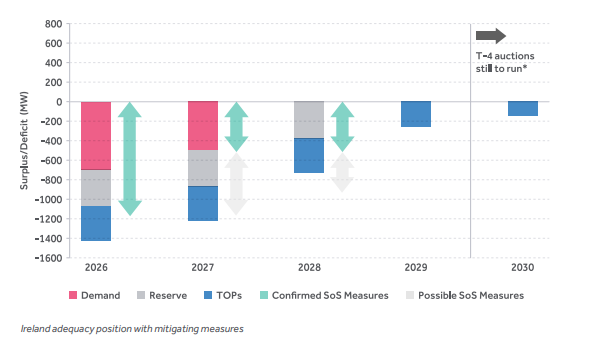
Published on 26 February, looks at the balance between electricity demand and supply in Ireland over 10 years. It found that from 2026 to 2028 the system is outside of the Reliability Standard of 3 hours, meaning additional capacity is required.
In the base assessment, 1,010MW is required in 2026, dropping to 220MW by 2028. In the secure assessment, which reflects more challenging conditions, 1,420MW is required in 2026, dropping to 730MW in 2028. Throughout this period, the delivery of the new Celtic interconnector, along with new gas plant capacity improves the outlook, reducing the LOLE in both assessments.
From 2029, the base assessment is within Reliability Standard, meaning there is sufficient capacity to operate the system under normal conditions. The secure assessment, however, remains outside of standard indicating around 200MW is required increasing to over 400MW in 2034.
The report noted that a key driver for electricity demand in Ireland is the connection of data centres and other new technology loads (NTLs). In Ireland, there is approximately 2,100 MVA of demand capacity that is contracted to data centres and other new technology loads at the transmission level, and approximately a further 300 MVA contracted at the 110 kV distribution level (managed by ESB Networks).
Although it was noted that in response to the challenging adequacy position, the Commission for the Regulation of Utilities (CRU) is undertaking a programme of work to provide additional stability and resilience to the power system in Ireland. As part of these actions the CRU directed EirGrid to procure Temporary Emergency Generation (TEG) and Retain Existing Units (REU). While these measures improve the adequacy position, the measures are temporary. As such it remains crucial that the capacity market delivers new capacity in a timely fashion, and the type and volume of capacity needed to underpin the energy transition.
Latest energy insights
-

9 April 2026
3 minute read
Energy price volatility: why it persists and what businesses can do about it
Read More -
9 April 2026
3 minute read
Unlocking the full value of battery storage through intelligent dispatch
Read More -
 Press Release
26 March 2026
3 minute read
GridBeyond and Optima Energy sign agreement to help customers unlocking new revenues
Read More -

26 March 2026
4 minute read
How AI is helping data centres lead the next wave of grid flexibility
Read More -
 Brochure
24 March 2026
1 minute read
Whitepaper| USA | Risk transfer solutions in merchant energy markets | Downside protection strategies for battery storage assets
Read More