News
better business decisions
Posted 3 months ago | 2 minute read

Energy-related emissions in Ireland fall, but more action needed
Energy-related emissions in Ireland have fallen by 16% since 2018, with electricity-related emissions decreasing by 32%, according to the Sustainable Energy Authority of Ireland (SEAI).
In its Energy in Ireland 2025 report, SEAI said Ireland‘s energy-related emissions in 2024 were at their lowest level in over 30 years (30.9 MtCO2eq) and down 1.5% on 2023-levels. This reduction was achieved despite population growth, an increase in electricity demand, and a growing economy. But Ireland’s energy-related emissions are falling at a rate of just 2.7%, short of the 5% pace needed to meet the country’s 2030 climate commitments.
Electricity accounted for 22.5% of energy-related emissions in 2024, with transport accounting for 37.7% and heat accounting for 39.8%.
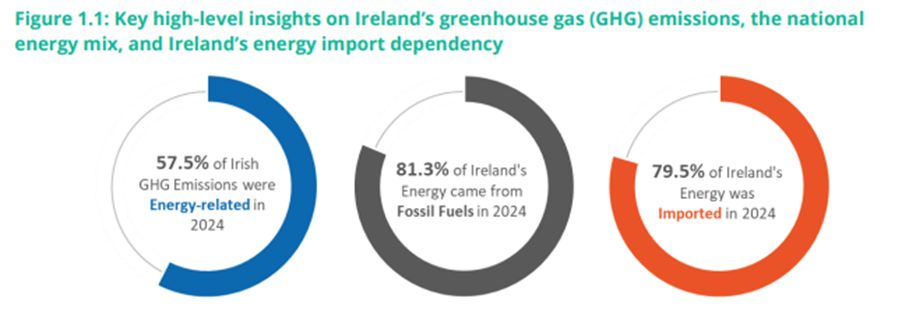
Source: SEAI
Electricity emissions were down 8.3% year-on-year. 14.6% of Ireland’s primary energy was renewable in 2024; the highest value to date. Ireland used 1.31TWh more renewable energy in 2024 than in 2023, with just under three-quarters of renewable energy in 2024 coming from wind, biodiesel, and biomass. Solar PV generation was up 69% and ambient heat capture from heat-pumps was up 19% in 2024. SEAI forecasts that Ireland’s electricity emissions to the end of 2025 at 6.5MtCO2eq of electricity emissions, which would be down 6% on 2024 levels
Transport, where 93% of the infrastructure is currently fossil fuel-powered, is a particular area of concern. Transport emissions fell 1.2% and heat-related emissions were reduced by 2.4%.
To keep Ireland on track, SEAI called for a faster rollout of wind and solar PV generation, energy upgrades for homes, heat-pumps, and electric vehicles, as well as new investment in district heating networks and grid and storage infrastructure.
Latest energy insights
-
 Press Release
26 March 2026
3 minute read
GridBeyond and Optima Energy sign agreement to help customers unlocking new revenues
Read More -

26 March 2026
4 minute read
How AI is helping data centres lead the next wave of grid flexibility
Read More -
 Brochure
24 March 2026
1 minute read
Whitepaper| USA | Risk transfer solutions in merchant energy markets | Downside protection strategies for battery storage assets
Read More -
 Press Release
17 March 2026
3 minute read
Samsung Ventures joins GridBeyond’s shareholder base as part of a €12M equity investment
Read More -

16 March 2026
4 minute read
What is demand flexibility and what opportunities does it offer businesses?
Read More -

16 March 2026
2 minute read
Government reforms could see data centres prioritised in connection queue
Read More -

16 March 2026
7 minute read
From volatility to value: how businesses can take control of their energy future
Read More