News
better business decisions
Posted 2 weeks ago | 4 minute read

High energy prices stifling UK manufacturing
High energy prices are undermining manufacturing competitiveness and delaying investment decisions, according to a joint report from the Confederation of British Industry (CBI) and Energy UK.
Published on 22 February the Cutting Business Energy Costs: The case for action report, warns that rising energy bills are forcing companies to rethink expansion plans, with CBI survey data showing almost 90% of businesses had seen energy costs increase over the past three years and four in ten planned to cut back investment as a result.
The report notes that UK companies face some of the highest electricity costs in the developed world, with industrial prices nearly two-thirds above the median of IEA countries and the highest in the G7. For medium-sized companies, electricity prices are around double the EU median, creating a significant disadvantage against overseas competitors and increasing the risk of production moving abroad. Sectors receiving support, such as steel, can still pay 14%-25% more for electricity than counterparts in France and Germany. The result is not only damaging to international competitiveness, but also risk hindering the scale-up of low-carbon technologies that underpin energy security and resilience.
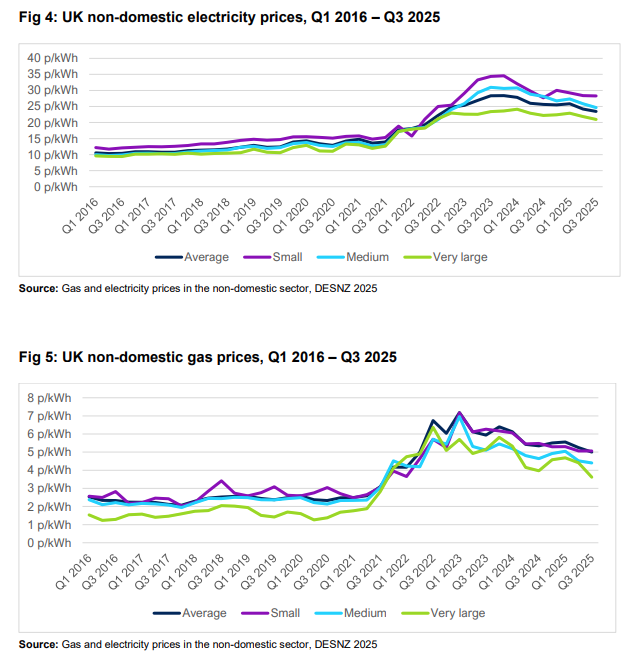
The report concluded that without further government intervention or policy reform, there is a real risk that the pressures of energy costs on businesses will intensify in the near term. Although wholesale energy prices have fallen significantly from the peak of the energy crisis, they remain highly volatile. Meanwhile, network charges are set to rise significantly from April 2026.
It called for development of a national strategy on business energy costs to enhance competitiveness and security, as well as drive sustained investment and economic growth. The strategy should:
- convene a cross-government forum that brings together DBT, DESNZ, HMT and Ofgem for regular ministerial reviews of business energy costs and actions being taken to address them
- conduct a comprehensive review of the effects of current and future policy and network charges on business energy costs and resilience, identifying options to mitigate these impacts
- evaluate the performance of current and future business energy bill support mechanisms, from capital programmes and funds to targeted sector support, to identify where enhancements or new measures are required
- introduce tools that help businesses to develop robust energy strategies and improve energy efficiency
- collaborate with the energy industry to assess market design options and regulatory change that could cut energy costs
What are the cost components within a business energy bill?
Business energy bills in the UK are more complex than a simple charge based on the wholesale price of electricity or gas, they are comprised of numerous elements, including the cost of developing and maintaining energy networks, suppliers’ operating costs and profit margin, and charges covering environmental schemes.
- wholesale costs: the cost per kWh of energy bought in markets or under contracts. For electricity this is set by the ‘marginal generator’ i.e. the cost of the most expensive generator on the system needed at any point in time to meet demand; for gas, it is set by the marginal source of supply, which is the cost of the last unit of gas needed to meet demand
- network costs: covers the cost of developing, maintaining and upgrading energy distribution and transmission infrastructure
- policy costs: levies imposed on energy suppliers and passed through to customers, which fund policies and mechanisms mandated by government. These include the Renewables Obligation, Contracts for Difference, Feed in Tariff and Capacity Market
- operating costs: the day-to-day costs a supplier incurs to run its business, including administration, billing, customer service
- other costs: other charges including commission paid to third party intermediaries for their services
- taxes: most businesses pay 20% VAT on energy (which most businesses can then reclaim). The Climate Change Levy (CCL) is a government-imposed tax on non-domestic energy consumption, charged per unit to reduce carbon use

Intelligent demand side response- White Paper
In today’s fast-paced industrial landscape, optimising production schedules isn’t just about meeting deadlines; it’s also about navigating volatile energy prices. Fluctuations in energy costs can significantly impact operational expenses, making it imperative for businesses to devise strategies that mitigate against these costs.
Learn moreLatest energy insights
-
26 February 2026
2 minute read
Energy demand putting strain on system, says All-Island Resource Adequacy Assessment
Read More -

25 February 2026
3 minute read
Why electricity prices matter and what businesses can do about it
Read More -

24 February 2026
4 minute read
Smart energy strategies: how education institutions can save money and boost sustainability
Read More -
20 February 2026
4 minute read
Ofgem and NESO consult on market reforms: what large energy users need to know
Read More