News
better business decisions
Posted 1 month ago | 3 minute read

NERC identifies resource adequacy risks to 2030
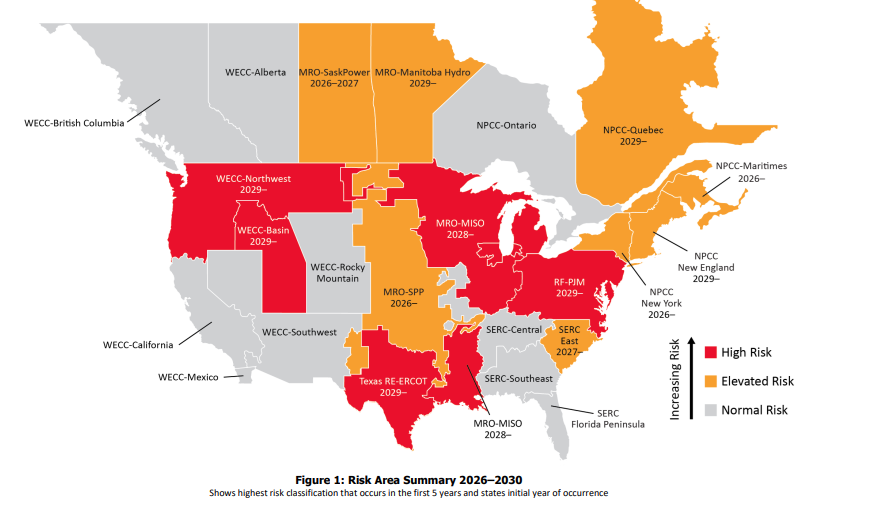
NERC has said it is expecting intensifying resource adequacy risks throughout the North American bulk power system (BPS) over the next 10 years.
In its 2025 Long-Term Reliability Assessment NERC noted that Summer peak demand is forecast to grow by 224GW, a more than 69% increase over the 2024 forecast with new data centers for artificial intelligence and the digital economy accounting for most of the projected increase. Winter demand growth continues to outpace summer demand growth with 246GW of growth forecast over the next 10 years, reflecting the evolution of electricity usage. The risk of electricity supply shortfalls increases during winter conditions, as generators with diverse fuels retire and are replaced predominantly by solar and batteries and natural-gas-fired generators.
Source: NERC
For PJM, NERC said demand for electricity is growing at its fastest pace in years, driven primarily by data centers, followed by electrification and manufacturing loads. PJM summer peak demand is expected to grow by 56GW to a total of 210GW in 2035, and its winter peak demand is expected to reach 198 GW by winter 2034–35. PJM’s annual net energy for load growth rate is projected to average 4.8% per year over the next 10 years, up from 2.3% in last year’s projections. At the same time, PJM faces an extreme and rapid tightening of capacity resources in the near term because of generator retirements and project delays. A large share of PJM’s new interconnection requests is from variable energy resources, approximately 40% of which are solar, and dispatchable resources are currently leaving the system faster than they can be replaced with other dispatchable technologies.
NERC noted that the ERCOT assessment area is forecast to experience continued rapid electric demand growth over the next 5–7 years. Forecast summer peak total internal demand is expected to increase from 94,650MW for 2026 to 154,077MW for 2035, an average annual increase of 5.6%. This load growth is mainly driven by forecasted interconnections of large loads totaling 45GW by 2030, of which 23GW are data centers. For Summer 2026, demand response (DR) contributes 13.3GW to resource adequacy (up from the 2.7GW projection in the 2024 assessment), and contributions from DR rise to 53.1 GW by 2030.
To mitigate the reliability challenges, NERC recommends streamlining infrastructure development (both gas and electric), managing generator deactivations, undertaking robust adequacy assessments, and coordinating electric-natural gas system planning and operations.
Specific recommendations included:
- Integrated Resource Planners, market operators, and regulators should expedite new resources to meet growing demand and carefully manage generator deactivations.
- NERC, industry, and regulators should understand and manage reliability risks accompanying large-load growth and leverage potential capabilities in new types of loads to provide flexibility to operators during times of grid stress.
- NERC, the Regional Entities, and industry should improve the LTRA by incorporating wide-area analysis, risk scenarios, and criteria to inform stakeholders of future reliability risks.
- Regulators and policymakers should streamline siting and permitting processes to remove barriers to resource and transmission development.
- Regional Transmission Organizations, Independent System Operators, and the Federal Energy Regulatory Commission (FERC) should continue to ensure that essential reliability services are maintained.
Latest energy insights
-
 Press Release
26 March 2026
3 minute read
GridBeyond and Optima Energy sign agreement to help customers unlocking new revenues
Read More -

26 March 2026
4 minute read
How AI is helping data centres lead the next wave of grid flexibility
Read More -
 Brochure
24 March 2026
1 minute read
Whitepaper| USA | Risk transfer solutions in merchant energy markets | Downside protection strategies for battery storage assets
Read More -
 Press Release
17 March 2026
3 minute read
Samsung Ventures joins GridBeyond’s shareholder base as part of a €12M equity investment
Read More -

16 March 2026
4 minute read
What is demand flexibility and what opportunities does it offer businesses?
Read More -

16 March 2026
2 minute read
Government reforms could see data centres prioritised in connection queue
Read More -

16 March 2026
7 minute read
From volatility to value: how businesses can take control of their energy future
Read More