News
better business decisions
Posted 17 hours ago | 2 minute read

Net zero will protect UK from fossil-fuel price shocks
The “cost” of reaching net zero is less than the cost of a single fossil-fuel price shock, according to a new report from the Climate Change Committee (CCC).
In its supplementary analysis of the Seventh Carbon Budget, published on 11 March the government’s climate advisor said that meeting the UK’s net zero target by 2050 will cost less than a single oil shock and bring health and economic benefits while insulating the country against future costs. It says that benefits could be worth an average of £110B per year to the UK from 2025-50, with a total net present value of £1,580B. It builds on the CCC’s seventh carbon budget, which found that it would cost the UK less than 0.2% of GDP per year to reach its net zero target.
According to the analysis a 2022-equivalent fossil fuel price spike occurring once over the period (modelled as 2040), would result in the average household energy bill increasing by 59% in the high-carbon baseline, but by only 4% in the Balanced Pathway. When considering costs to households, businesses and the Exchequer, the total additional cost of a single fossil fuel shock of 2022 magnitude is likely to be as large as the total net additional cost of meeting the Balanced Pathway across every year to 2050.
Although it noted that achieving Net Zero requires investment, it estimates that for every £1 spent there will be £2 to £4 in benefits. Avoiding climate damages is the most significant benefit of the transition. This saving is estimated between £40 billion and £130 billion in 2050.
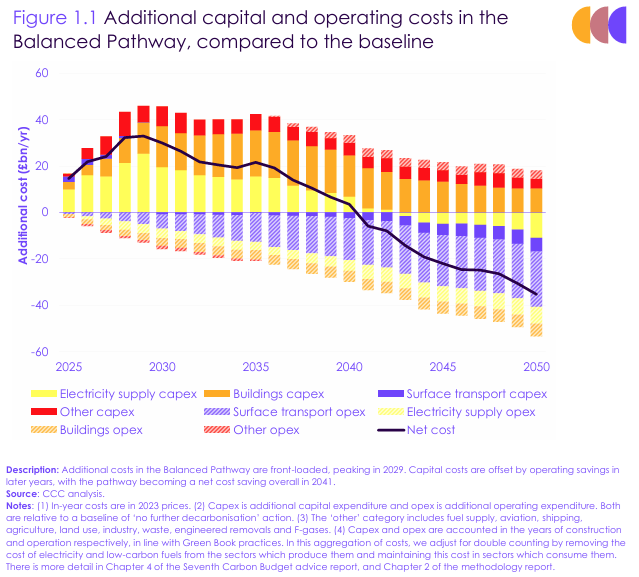
Source: CCC
Energy losses in today’s system were costed at £60B/year, which is equivalent to £2,000 per household. The report noted that in 2025, around 1,900TWh of primary energy input is required to generate a useful energy output of around 900TWh. Due to inefficiencies of fossil fuel combustion, more than half of the energy inputted is wasted rather than transformed into useful energy output. Energy losses in a net zero system are halved compared to today. In 2050, the system is dominated by electricity, largely generated by renewables. Losses in this system are valued at £30B/year.
The transition is also set to deliver far greater health and wellbeing co-benefits than costs. Cleaner air, warmer homes, more active travel and healthier diets strongly outweigh downsides like extra public transport time or potential congestion from increased EV use.
Latest energy insights
-
26 February 2026
2 minute read
Energy demand putting strain on system, says All-Island Resource Adequacy Assessment
Read More -

25 February 2026
3 minute read
Why electricity prices matter and what businesses can do about it
Read More -

24 February 2026
4 minute read
Smart energy strategies: how education institutions can save money and boost sustainability
Read More -
20 February 2026
4 minute read
Ofgem and NESO consult on market reforms: what large energy users need to know
Read More