News
better business decisions
Posted 3 months ago | 5 minute read

Unlocking hidden value in your generation | Class A License Exempt Supply
Independent renewable generators are a vital part of the UK’s energy mix. But as policy costs rise and wholesale markets remain volatile, maximising the commercial value of generation is becoming increasingly challenging. One underutilised route to improved returns is the Class A License Exempt Supply, a provision under the Electricity Order 2001 that allows small generators to supply demand customers without the full burden of social and policy charges. In this paper we explore what Class A exemption is and how it works and why 2025 represents a turning point for independent generators.
The changing landscape for small generators
The UK power market has undergone dramatic change over the past decade. Subsidy regimes that once underpinned small-scale renewables have closed to new entrants, at the same time, policy and system costs continue to rise, eroding the margins available under traditional Power Purchase Agreements (PPAs).
Independent generators, particularly those under 5MW, often find themselves squeezed: too large for tariff simplicity; too small for the trading flexibility available to larger players. Against this backdrop, new mechanisms are needed to level the playing field. The Class A Exempt PPAs offer such an opportunity. It enables small generators to bypass certain charges, create “virtual private wires” with demand customers, and secure improved value streams. While historically underutilised, recent regulatory changes and market conditions make Class A Exempt PPAs more relevant than ever.
What is License Exempt Supply?
Class A is a supply license exemption that allows small suppliers (defined as entities supplying no more than 5MW of electricity, of which no more than 2.5MW is to domestic premises on a half-hourly basis) to supply electricity to demand customers without paying the full range of government social and policy costs.
In practice, Class A exemption enables generators to match their output with demand customers in what’s often called a virtual private wire arrangement, creating savings on the demand side and boosting generator revenues.
This structure operates under The Electricity (Class Exemptions from the Requirement for a Licence) Order 2001, but recent regulatory changes have increased the viability of LES models by streamlining the splitting of licensed and licence-exempt supply.
BSC modification P442, which was approved by Ofgem in 2025, amends the Balancing and Settlement Code (BSC) to allow for licence-exempt supply volumes to be excluded from the calculation used to assign levies to licensed suppliers that fund the Government Electricity Market Reform (EMR) programme (including the Contracts for Difference and Capacity Market mechanisms). The EMR regulations only apply to licensed supply, not licence-exempt supply. This makes the financial proposition more attractive for generators, utilities (offtakers), and supply-side consumers.
Who can I supply power to under LES?
- Non-domestic customers up to a total of 2.5MWh per half-hourly period
- Domestic customers up to 1.25MWh per half-hourly period
What’s the size of the prize?
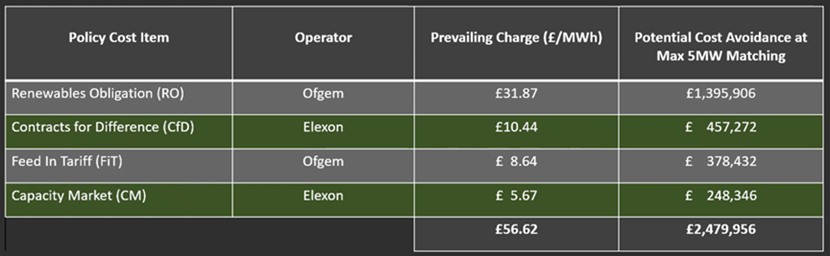
In standard supply contracts, suppliers are responsible for collecting and remitting environmental levies the costs are then typically recovered through charges applied to all electricity consumers. Under BSC Modification P442, volumes supplied via LES are excluded from these levy obligations. This means that for matched LES generation to consumption, neither the offtaker nor the end consumer is required to pay these charges, resulting in avoided costs
At today’s values, the maximum benefit from Class A exemption is around £2.5M per 5MW of capacity. But this figure is expected to rise over time, particularly as new policies such as the nuclear Regulated Asset Base (RAB) subsidy and the Climate Change Levy (CCL) take effect. This means, on average, independent generators can expect to see their PPA offer price increase 15%-20% compared with standard arrangements. This uplift represents a powerful lever for improving project economics, particularly for subsidy-free generation seeking to compete in a challenging wholesale market.
Is there a catch?
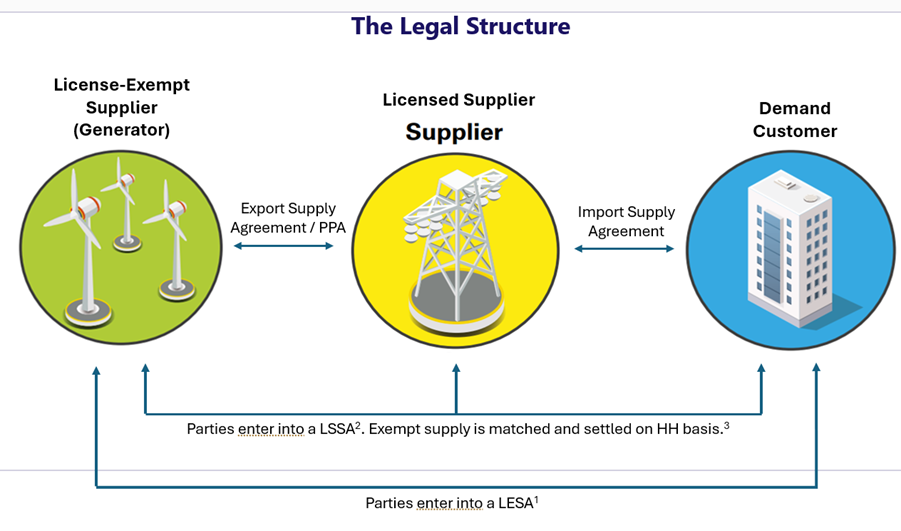
Class A exemption is more complex than a simple PPA and requires two additional contractual arrangements (on top of supply agreements: one between the Generator, Supplier and Demand Customer and the other between the generator and the demand customer).
The supplier, not the generator or the customer, is responsible for ensuring exempt volumes are matched on a half-hourly basis and treated correctly within industry settlement processes. But, once the frameworks are in place, the arrangement delivers substantial long-term value.
Why act now?
Class A exemption represents a unique and timely opportunity. With the right partners and contractual arrangements, it is possible to capture a meaningful uplift in revenues and future-proof your business against an evolving policy landscape.
With new benefits due to come into force in 2025, the opportunity for small independent generators has never been greater. Acting early allows generators to position themselves ahead of the curve, secure favourable terms with suppliers and demand partners, and lock in additional value.
Conclusion
Class A License Exempt Supply isn’t just a technical quirk in regulation, it’s an opportunity for small generators to make savings. but the benefits depend heavily on profile matching, contractual terms, and ongoing regulatory support.
By partnering with the right licensed supplier and structuring agreements correctly, independent generators can unlock additional value and future-proof their business.
GridBeyond’s solutions deliver:
- Price certainty: fixed-rate PPAs remove exposure to volatile market prices
- Rewards for high utilisation: ideal for CHP and AD plants with a strong baseload
- profile
- Non-commodity cost exemptions: Avoid CCL, BSUoS, DUoS, and more through
- demand matching
- Low complexity: No bidding. No balancing. No chasing peak pricing. Just clean power, sold.
Latest energy insights
-
 Press Release
26 March 2026
3 minute read
GridBeyond and Optima Energy sign agreement to help customers unlocking new revenues
Read More -

26 March 2026
4 minute read
How AI is helping data centres lead the next wave of grid flexibility
Read More -
 Brochure
24 March 2026
1 minute read
Whitepaper| USA | Risk transfer solutions in merchant energy markets | Downside protection strategies for battery storage assets
Read More -
 Press Release
17 March 2026
3 minute read
Samsung Ventures joins GridBeyond’s shareholder base as part of a €12M equity investment
Read More -

16 March 2026
4 minute read
What is demand flexibility and what opportunities does it offer businesses?
Read More -

16 March 2026
2 minute read
Government reforms could see data centres prioritised in connection queue
Read More -

16 March 2026
7 minute read
From volatility to value: how businesses can take control of their energy future
Read More