News
better business decisions
Posted 1 month ago | 2 minute read

Voluntary Scheduled Resources: explained
Voluntary Scheduled Resources (VSR) is a new participant category designed to enable dispatch of flexible loads and distributed energy resources (DER) in central dispatch withing the National Electricity Market (NEM).
On 19 December 2024, the Australian Energy Market Commission (AEMC) made a final determination and rule in the Integrating price-responsive resources into the NEM rule change (IIPR), which will allow aggregated consumer energy resources (CER), distributed energy resources (DER) and price-responsive loads to be scheduled and dispatchable in the NEM.
Currently, unscheduled price-responsive resources are not able to participate in dispatch, meaning they are not effectively integrated into the NEM’s planning and operation functions and are not visible to market operator or the electricity market. This restricts these resources from contributing to the real-time matching of supply and demand and from potential value streams accessible in the market.
At the end of November 2025 AEMO published its Final Voluntarily Scheduled Resources (VSR) Guidelines, Final Report, Final VSR zones maps, VSR Guidelines Zone Mapping Tool as part of implementing the IPPR rule.
The final rule establishes a framework, called “dispatch mode,” which allows for aggregated resources, such as virtual power plants (VPPs), small stand-alone generators or energy storage systems, community batteries, flexible loads and other price-responsive resources to participate in NEM dispatch. This includes the ability to bid into the market, set spot prices, receive and follow dispatch instructions, and participate in energy markets.
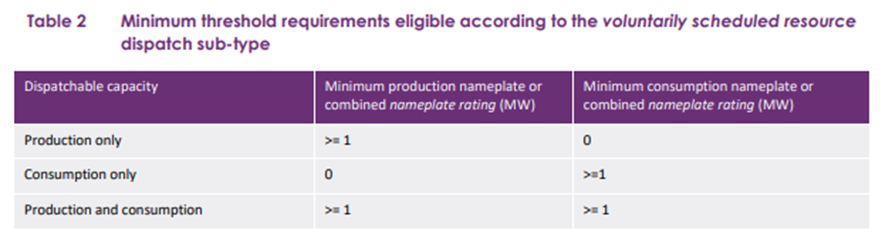
The minimum threshold for nameplate or combined nameplate rating of a voluntarily scheduled resource is 1 MW for production or consumption or both, depending on the dispatchable capacity1 of that voluntarily scheduled resource.
The IPRR dispatch mode commences in May 2027.
Latest energy insights
-
 Press Release
26 March 2026
3 minute read
GridBeyond and Optima Energy sign agreement to help customers unlocking new revenues
Read More -

26 March 2026
4 minute read
How AI is helping data centres lead the next wave of grid flexibility
Read More -
 Brochure
24 March 2026
1 minute read
Whitepaper| USA | Risk transfer solutions in merchant energy markets | Downside protection strategies for battery storage assets
Read More -
 Press Release
17 March 2026
3 minute read
Samsung Ventures joins GridBeyond’s shareholder base as part of a €12M equity investment
Read More -

16 March 2026
4 minute read
What is demand flexibility and what opportunities does it offer businesses?
Read More -

16 March 2026
2 minute read
Government reforms could see data centres prioritised in connection queue
Read More -

16 March 2026
7 minute read
From volatility to value: how businesses can take control of their energy future
Read More