News
better business decisions
Posted 2 months ago | 4 minute read
Winter storm tests US electric grid
This weekend Winter Storm Fern crossed the United States, blanketing much of the country in snow, ice, and record-low temperatures and putting the nation’s power grid under pressure.
Ahead of the storm, NOAA said it expected it to be an “unusually large and severe winter storm”. Cold air remains in the forecast for more than half of the US population through this week. The combination of significant snow and ice accumulations and frigid weather could cause power outages and icy roads to linger longer than usual after a typical winter storm.
On January 22, the US Department of Energy issued an emergency order allowing grid operators to direct data centers and other large energy consumers to use backup generators in order to preserve the Texas energy grid. “The Trump administration is committed to unleashing all available power generation needed to keep Americans safe during Winter Storm Fern,” said Energy Secretary Wright. The order is in effect from January 24-27, 2026.
As of 4:15 p.m. EST Sunday, Tennessee experienced the most outages in the country, at more than 308,000, according to PowerOutage.us. Mississippi had more than 149,000 customers without power, trailed by 138,000 in Louisiana, 103,000 in Georgia, 80,000 in Texas, 67,000 in Kentucky, 33,000 in West Virginia and 28,000 in South Carolina. Georgia Power said it restored power to 70,000 customers as of 4 p.m. EST, though another 70,000 concentrated in north Georgia and Atlanta are still without electricity.
PJM said on January 25, that peak demand for its footprint is expected to surpass 130,000MW for seven consecutive days for the first time ever, noting extreme cold conditions may persist through Feb. 1. As a precautionary measure, PJM activated some Demand Response customers on January 25 to address localized transmission constraints and to preserve the run-time of generators that will be needed for colder weather and higher electricity demand later in the week.
In its 2025–2026 Winter Reliability Assessment, NERC said much of North America is at an “elevated risk” of having insufficient energy supplies this winter to meet demand in extreme operating conditions. Published on November 18, the report noted that although resources are adequate for normal winter peak demand, any prolonged, wide-area cold snaps will be challenging. This is largely due to rising electricity demand, which has grown by 20.2GW (2.5%) since last winter’s forecast, significantly outpacing winter on-peak capacity. This, coupled with the changing resource mix, is affecting the winter outlook.
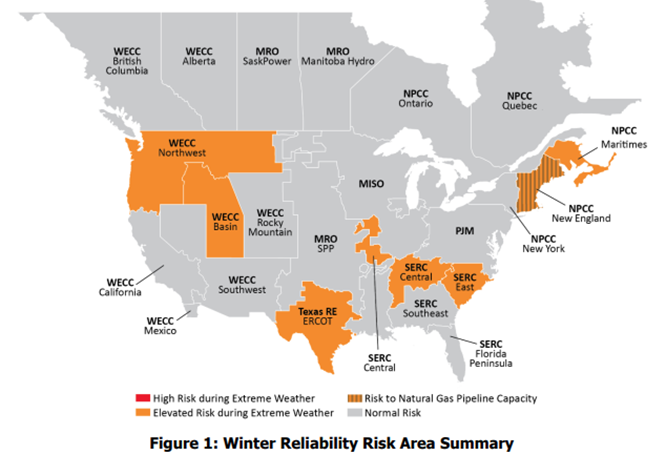
Source: NERC
Generation and storage resources are growing, but at a slower rate than demand is rising. Battery and solar facilities were the leading resource types added since last winter. Total resources serving winter peak demand, including generating capacity and demand response, have increased since last winter by 9,447MW. Sizeable additions in battery resources and some new natural gas-fired generators contribute to the increase in resource capacity. But the increase is offset by lower on-peak capacity values for wind resources. As a result, generator capacity for winter peak demand makes up only a small portion of the total increase. Generation accounts for 1,335MW of the total 9,445MW increase, while the larger share comes from demand response programs.
For the ERCOT region, which was noted to be at elevated risk, the report noted that strong load growth from new data centers and other large industrial end users is driving higher winter electricity demand forecasts and contributing to continued risk of supply shortfalls. For the upcoming winter season, ERCOT is expected to continue facing reserve shortage risks during the peak load hour and high-net-load hours, particularly under extreme load conditions that accompany freezing temperatures. Elevated forced outage of thermal resources and reduced output from intermittent resources during these conditions exacerbates the risk of supply shortfalls. In winter, peak demands typically occur before sunrise and after sunset coinciding with the unavailability of solar generation making the system dependent on wind generation and dispatchable resources.
Data centers are altering the daily load shape due to their round-the-clock operating pattern, lengthening peak demand periods. Additional battery storage and demand-response resources since last winter help mitigate shortfall risks. But with the continued flattening of the load curve, maintaining sufficient battery state of charge will become increasingly challenging for extended periods of high loads, such as a severe multi-day storm like Winter Storm Uri.
Latest energy insights
-
 Press Release
26 March 2026
3 minute read
GridBeyond and Optima Energy sign agreement to help customers unlocking new revenues
Read More -

26 March 2026
4 minute read
How AI is helping data centres lead the next wave of grid flexibility
Read More -
 Brochure
24 March 2026
1 minute read
Whitepaper| USA | Risk transfer solutions in merchant energy markets | Downside protection strategies for battery storage assets
Read More -
 Press Release
17 March 2026
3 minute read
Samsung Ventures joins GridBeyond’s shareholder base as part of a €12M equity investment
Read More -

16 March 2026
4 minute read
What is demand flexibility and what opportunities does it offer businesses?
Read More -
16 March 2026
2 minute read
Government reforms could see data centres prioritised in connection queue
Read More -

16 March 2026
7 minute read
From volatility to value: how businesses can take control of their energy future
Read More