News
better business decisions
Posted 3 months ago | 3 minute read
Electricity system “structurally failing manufacturers”, says Make UK
Manufacturers are warning of an estimated £85B hit if the UK Government does not act to reduce industrial electricity prices, according to a report by Make UK.
From Crisis to Stability: A Future Energy System for Manufacturerssaid the UK’s electricity system is “structurally failing manufacturers”. It notes that when gas sets the price, wholesale electricity prices are higher. In 2025 the UK was using gas as the price setter for 75%-80% of hours, with average day-ahead prices above €90/MWh. This is compared to Finland, which has gas setting prices just 15% of the time, with average prices around €42/MWh. It also noted that policy levies are loaded onto electricity bills, and slow grid connections, ageing infrastructure and inefficient post-Brexit energy trading arrangements add further cost and complexity for UK businesses.
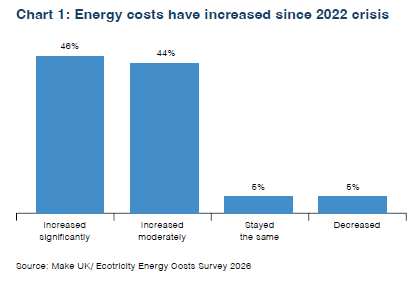
The report, published on 6 July, found that 90% of manufacturers said energy bills have increased at least moderately since 2022, while more than half of the companies identified energy costs as their biggest challenge over the coming years. 13% say further projected energy cost rises could threatened their operative viability. Make UK estimated that a 13% decline in UK manufacturing activity could mean an annual loss of £85B to the economy. The report also highlighted how high energy costs are feeding through the wider economy, with seven in ten manufacturers passing higher bills on to consumers while rising costs squeeze margins and delay investment.
Source: Make UK
Despite these pressures, manufacturers remain committed to net zero and see the transition as a route to greater resilience, with 71% noting that net zero is important to their operations.
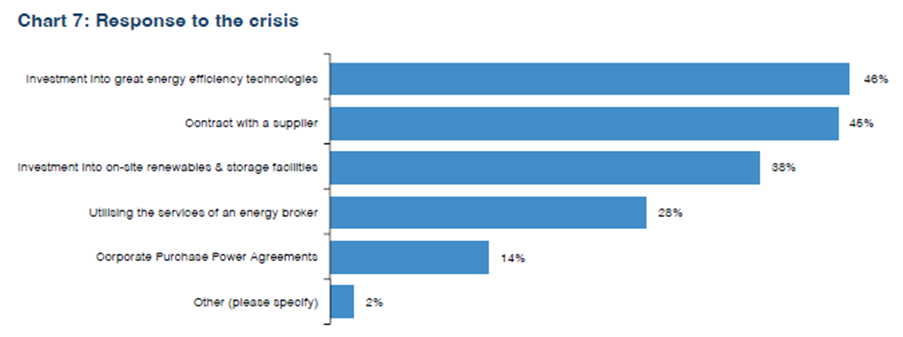
It notes that manufacturers are taking several steps to address a challenging business environment utilising decarbonisation as a route to reduce operating costs and remain competitive, with many investing into energy efficiency, on-site renewables and energy storage or through energy procurement mechanisms. But it called on policy-makers to take further action to support UK manufacturing.
Source: Make UK
Make UK is calling on the government to:
- deliver the British Industrial Competitiveness Scheme this year and extend to all manufacturers
- move electricity policy levies into general taxation to provide immediate relief for manufacturers
- expand business rates relief for green investment
- create a successor to the Industrial Energy Transformation Fund
- accelerate structural reform of the electricity market
- reform the grid so it prioritises existing industrial demand
For energy-intensive businesses, electricity is no longer a passive overhead. Wholesale prices can fluctuate significantly within short timeframes, and peak price events can materially increase operating costs. Production schedules are often built around static operating parameters, historic assumptions or manual decision-making, which means valuable opportunities to reduce costs, avoid price peaks or earn flexibility revenue can be missed.
At GridBeyond we help businesses across the UK and Ireland to reduce exposure to high and volatile energy prices. Using advanced solver-based optimisation, digital twin technology, AI forecasting and automated control FlexPilot identifies when and how a site can shift, reduce or optimise energy use while respecting operational and asset-level constraints. The core proposition is to unlock maximum energy flexibility without impacting production, safety or stability.

Unlocking the power of energy | FlexPilot
By extending demand response strategies into day-to-day production planning, companies can unlock hidden value, maximize savings, and take control of energy costs across single or multiple sites.
Learn moreLatest energy insights
-
15 October 2026
6 minute read
Following the forecast: the hidden risk in battery optimization | Q&A
Read More -
7 October 2026
4 minute read
Private wires in Ireland: a new route to power for data centres and industry?
Read More -

7 October 2026
7 minute read
What is a distributed energy network, and why are businesses building their operations around one?
Read More -
25 September 2026
3 minute read
The age of electricity: the growing role of electricity in economies and energy systems
Read More -
 Awards
News
Awards
News
17 September 2026
2 minute read
GridBeyond named a Business Energy Achievement Awards winner for innovation in data centre energy flexibility
Read More -

17 September 2026
2 minute read
MPs call for removal of “net zero” from government terminology
Read More