News
better business decisions
Posted 2 months ago | 11 minute read
Virtual Power Plant vs DERMS vs aggregation: what’s the difference?
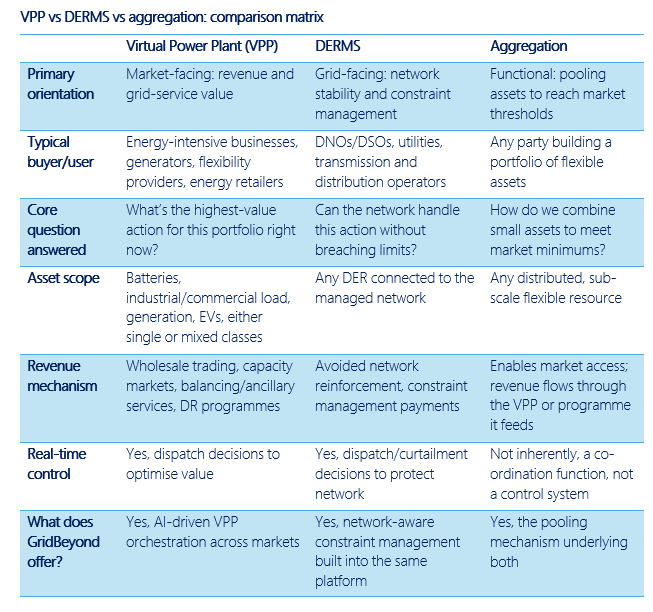
A Virtual Power Plant (VPP) is software that aggregates and dispatches distributed energy resources, such as batteries, flexible industrial load, and on-site generation, as a single, market-facing asset. A DERMS (Distributed Energy Resource Management System) is software that gives a grid operator visibility and control over those same resources at the network level, to manage constraints like voltage and thermal limits. Aggregation is the underlying function both rely on: pooling many small, individually sub-scale assets so they can meet the minimum size thresholds required to participate in energy markets. In essence, VPPs perform aggregation, DERMS platforms increasingly aggregate too, and some platforms, including GridBeyond’s, are built to do all three at once.
This article sets out what each one does, where its boundaries lie, and why a growing number of platforms (including GridBeyond’s) are converging functionality into one system.
What Is a Virtual Power Plant (VPP)?
A Virtual Power Plant is a software platform that combines distributed energy resources, such as battery storage, demand response from flexible industrial and commercial load, on-site generation, and increasingly EVs, into a co-ordinated portfolio that behaves, from the grid and market’s perspective, like a single large power plant. Instead of building a physical peaking plant, a VPP uses software and real-time data to call on a network of smaller, distributed assets to increase or decrease their output or consumption in response to price signals, grid needs, or contracted grid services.
The defining feature of a VPP is its market orientation. A VPP exists to capture revenue and deliver grid value by trading flexibility into wholesale energy markets, capacity markets, ancillary/balancing services, and demand response programmes. It is a commercial optimisation engine sitting on top of a technical control layer.
The best VPP platforms use AI and machine learning to forecast prices, forecast asset availability, and automatically decide, often in real time and without manual intervention, which market to bid into and which assets to dispatch to capture the highest value while respecting each asset’s operational constraints.
VPPs can be built from a single asset class (battery-only VPPs are common) or from a mix of asset types. That distinction matters when it comes to performance and resilience.
What is a DERMS?
A Distributed Energy Resource Management System (DERMS) is software used by network operators, utilities, and grid operators to monitor, forecast, and control distributed energy resources connected to their network.
DERMS platforms give network operators visibility down to individual connection points and the ability to issue constraint-driven instructions, such as curtailing generation, throttling charging, or dispatching storage, to keep the local network within safe operating limits. This grid-edge orientation is what separates a DERMS from a VPP. Though in practice the technology between a DERMS and VPP is similar: both need real-time telemetry, forecasting, and dispatch logic across large fleets of heterogeneous assets. This means that as DER penetration grows, DERMS and VPP functions are increasingly converging.
Grid operators need commercial mechanisms to compensate flexibility providers for helping manage constraints, and VPP operators need constraint-awareness to avoid actions that would breach network limits. That convergence is a major reason platforms like GridBeyond’s are built to operate as both at once, rather than as two separate systems bolted together.
What is aggregation?
Aggregation is the operational and commercial function of pooling multiple smaller distributed energy resources so that, collectively, they meet the minimum capacity or volume thresholds required to participate in wholesale energy markets, capacity markets, or grid services programmes that individual small assets couldn’t access on their own. An aggregator is the entity that performs this pooling, along with the metering, verification, and settlement needed to prove delivery of contracted flexibility.
Aggregation is best understood as a function: it’s what a VPP does when it combines assets into a tradable portfolio, and it’s what a DERMS does when it groups assets for constraint management. Aggregator is the term historically used in demand response markets but as markets and as technology has developed “aggregator” and “VPP operator” are becoming used interchangeably, though a VPP is the platform and portfolio, while aggregation is the mechanism that builds it.
Why the lines are blurring
Five years ago, VPP and DERMS platforms were built by different vendors for different buyers. As distributed generation, storage, and flexible load scale up on local networks, network operators need commercial tools to actively manage these assets, which pulls DERMS toward VPP-style market mechanics. At the same time, VPP operators increasingly need to prove to network operators that their dispatch won’t create local constraint problems, which pulls VPPs toward DERMS-style network awareness.
The result is that the strongest platforms are the ones built from the outset to handle both functions. Platforms built on shared data infrastructure, providing one real-time view of every connected asset, one forecasting engine, one optimisation layer that can weigh market value and network constraints simultaneously perform better than segregated systems.
Hybrid VPPs vs. single asset class VPPs
A meaningful share of VPPs on the market today are built around a single asset class (battery-only VPPs are the most common example). Single-asset-class VPPs are simpler to build and market, but they carry structural disadvantages that compound over time:
- correlated risk: a battery-only VPP’s entire revenue stack depends on one technology’s performance characteristics, degradation curve, and duration limits. When battery economics in a given market compress the whole portfolio’s earning power moves in the same direction at once
- limited flexibility duration and depth: batteries typically deliver flexibility for one to four hours before needing to recharge. Industrial demand response can often sustain a load reduction for much longer. Generation assets contribute in different market conditions again. A single-asset VPP is structurally capped by that asset class’s operating profile no matter how sophisticated the software layer is
- weaker market participation: many of the highest-value grid services reward portfolios that can guarantee delivery across a range of conditions and durations. A hybrid portfolio combining fast-responding batteries, flexible industrial load, and dispatchable or renewable generation can credibly bid into a wider range of products than any single asset class can alone
- better reliability under stress: if one asset class underperforms, a hybrid portfolio has other asset classes to lean on to still deliver the contracted service. Underperformance in a single-asset-class portfolio impacts the whole VPP
A VPP built on batteries, industrial load, and generation together is structurally more resilient, more flexible across time durations, and able to participate in a wider set of markets than any single-asset-class VPP of equivalent size.
Where GridBeyond fits
GridBeyond’s Platform is built to operate as a VPP and a DERMS on the same underlying AI infrastructure, rather than as separate products. The platform combines real-time telemetry, forecasting, and optimisation across batteries, flexible industrial and commercial load, and on-site generation, giving customers and grid partners one system that can simultaneously chase the highest-value market action and respect network constraints.
Because GridBeyond’s VPP portfolios are hybrid by design, customers benefit from diversification effects a wider range of market products and a more resilient revenue stack than a single-asset-class VPP can offer.
Independent, third-party assessment is a useful reference point when comparing VPP platform vendors, since the market includes everything from pure-play software providers to large technology firms and utility-owned platforms, all describing their capabilities differently.
In its most recent published edition, Guidehouse Insights examined 16 VPP platform providers and rated them against criteria spanning vision, go-to-market strategy, partners and investors, DERMS integration strategy, technology scope, geographic reach, sales and distribution, platform performance, value chain capture, project portfolio, and business model with the report noting the growing trend of VPP and DERMS strategies merging. GridBeyond was named among the top five vendors assessed in that report.
Beyond the Guidehouse Leaderboard, GridBeyond’s capabilities have been independently recognised by industry bodies, analysts, and awards programmes over several years:
AI-powered energy intelligence
Recognition of the AI-driven decision-making layer that forecasts energy conditions, automates decisions, and continuously identifies the highest-value action for each asset.
2026 — Environment+Energy Leader Awards, Digital Transformation
2025 — Environment+Energy Leader Awards, Product: Software + Cloud
2024 — Environment+Energy Leader Awards, Product Innovation
2019 — BusinessGreen Technology Awards, Smart Grid Technology of the Year
2018 — it@cork Leaders Awards, Smart Technology Innovation
2017 — European Commission, Seal of Excellence
VPP and distributed energy orchestration
Recognition for proven VPP and DER orchestration capability, aggregating batteries, flexible demand, generation, and other distributed assets into coordinated, grid-responsive portfolios.
2024 — Darcy Partners, Top 10 Innovators in DER Management
2020 — Global Cleantech 100, World-Leading Technology Innovator
2019 — S&P Global Platts Global Energy Awards, Grid Edge Award
2019 — Frost & Sullivan, European Demand Response Technology Innovation
2019 — Decentralised Energy Awards, Industrial Award
2018 — S&P Global Platts Global Energy Awards, Grid Edge Finalist
Energy trading, forecasting, and market optimisation
Recognition for continuously optimising asset participation, combining market access, advanced forecasting, trading expertise, and automated optimisation to generate revenue from flexible assets.
2024 — Energy Risk Awards, Technology of the Year
2019 — S&P Global Platts Global Energy Awards, Grid Edge Award
2019 — Free Electrons, Energy Transition Accelerator
2019 — Frost & Sullivan, Excellence in European Demand-Side Response
Multi-asset and cross-technology optimisation
Recognition for technology-agnostic optimisation integrating batteries, industrial loads, EV infrastructure, and generation while respecting each asset’s operational constraints (the hybrid-portfolio approach).
2025 — Transport & Energy Awards, Best Product or New Technology
2024 — EVies, Best New Services, C&I and Public
2019 — Decentralised Energy Awards, Industrial Award
2019 — International Beverage Awards, Best Sustainability Innovation
2019 — S&P Global Platts Global Metals Awards, Finalist
Measurable energy-transition impact
Recognition for sustainability delivered commercially, converting advanced energy technology into tangible commercial, operational, and decarbonisation outcomes.
2026 — Environment+Energy Leader Awards, Digital Transformation for Smarter, Net-Zero Energy Systems
2025 — Transport & Energy Awards, Energy Leadership / Environmental Excellence
2020 — Global Cleantech 100
2019 — International Beverage Awards, Sustainability Innovation
2019 — BusinessGreen Technology Awards, Smart Grid Technology of the Year
Global scalability
Recognition for successfully transferring GridBeyond’s technology and expertise across geographies, regulatory structures, and electricity markets.
2025 — Asia Matters Business Awards, Climate Tech Exporter of the Year
2025 — Asia Matters Business Awards, Exporter of the Year
Frequently asked questions
Is a VPP the same as a DERMS?
No. A VPP is market-facing; it exists to trade flexibility for revenue. A DERMS is grid-facing and exists to manage network constraints for a utility or network operator. Many modern platforms, including GridBeyond’s, are built to deliver both functions from shared data and optimisation infrastructure.
Is aggregation the same as a VPP?
Aggregation is the pooling function a VPP relies on to reach market participation thresholds. A VPP is the broader platform and portfolio; aggregation is one of the mechanisms it performs. In demand response markets specifically, “aggregator” is often used as a near-synonym for VPP operator.
Do VPPs need to include batteries?
No. VPPs can be built from batteries, flexible industrial or commercial load, on-site generation, EVs, or any combination. Single-asset-class VPPs (commonly battery-only) are common, but hybrid VPPs combining multiple asset classes tend to be more resilient and able to participate in a wider range of market products.
Who uses a DERMS versus a VPP?
DERMS are typically used by distribution network operators (DNOs/DSOs) and utilities managing local network constraints. VPPs are typically used by energy-intensive businesses, generators, and flexibility providers seeking to monetise flexible assets in wholesale and grid-service markets. Increasingly, the same underlying platform serves both audiences.
Glossary
Virtual Power Plant (VPP)
A software platform that aggregates and dispatches distributed energy resources (such as batteries, flexible load, generation) as a co-ordinated, market-facing portfolio.
DERMS (Distributed Energy Resource Management System)
Software used primarily by network operators to monitor and control distributed energy resources to maintain grid stability within network constraints.
Aggregation
The function of pooling multiple smaller distributed energy resources to meet the minimum size thresholds required for market participation.
Hybrid VPP
A Virtual Power Plant built from more than one asset class, for example, batteries, industrial demand response, and generation together, rather than a single asset type.
Demand Response (DR)
The practice of adjusting electricity consumption, typically at industrial or commercial sites, in response to price signals or grid operator requests.
BESS (Battery Energy Storage System)
A battery-based asset used to store and discharge electricity, commonly one component of a VPP portfolio.
Latest energy insights
-
15 October 2026
6 minute read
Following the forecast: the hidden risk in battery optimization | Q&A
Read More -
7 October 2026
4 minute read
Private wires in Ireland: a new route to power for data centres and industry?
Read More -
7 October 2026
7 minute read
What is a distributed energy network, and why are businesses building their operations around one?
Read More -
25 September 2026
3 minute read
The age of electricity: the growing role of electricity in economies and energy systems
Read More -
 Awards
News
Awards
News
17 September 2026
2 minute read
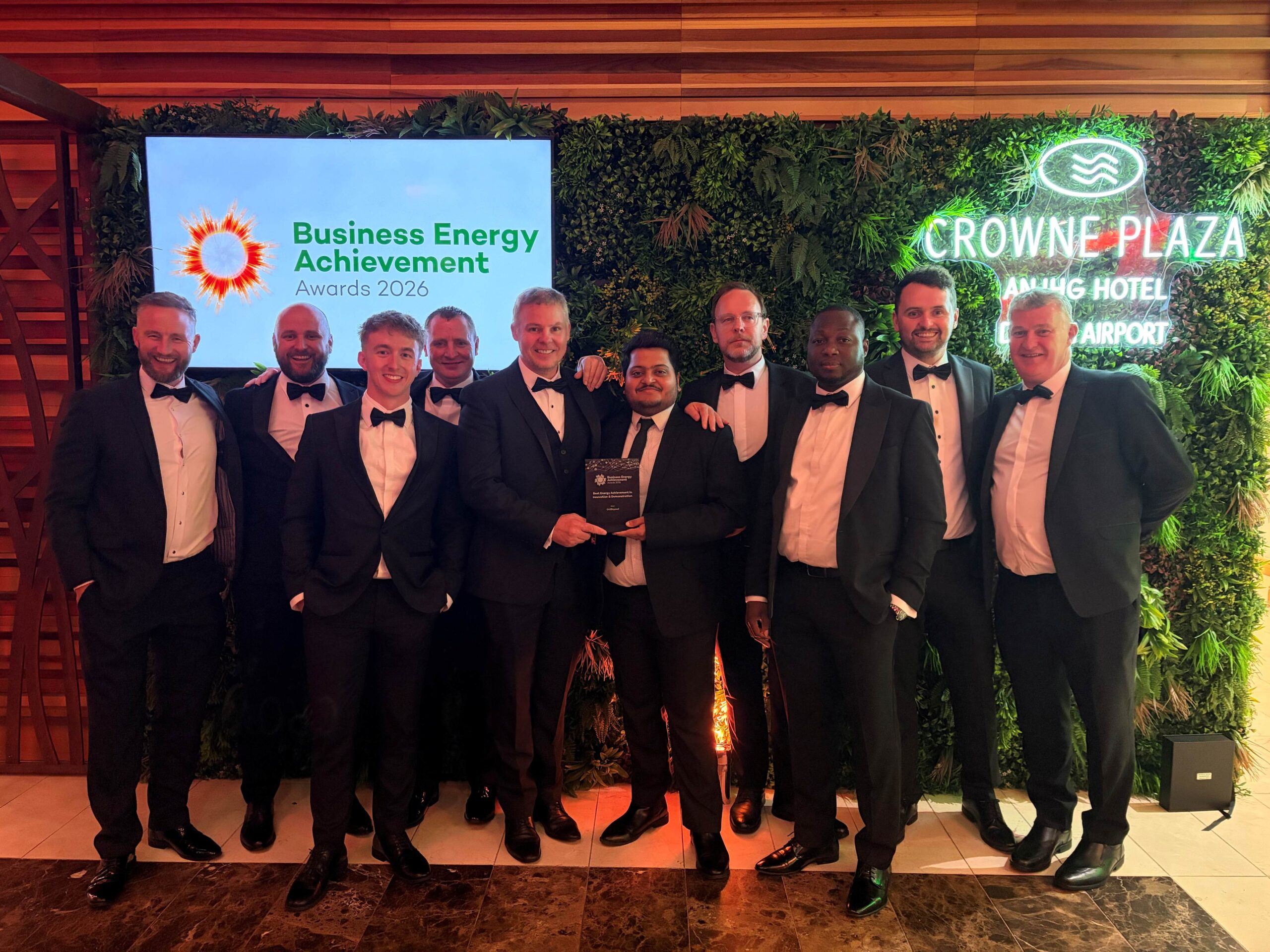
GridBeyond named a Business Energy Achievement Awards winner for innovation in data centre energy flexibility
Read More -

17 September 2026
2 minute read
MPs call for removal of “net zero” from government terminology
Read More