News
better business decisions
Posted 12 hours ago | 7 minute read
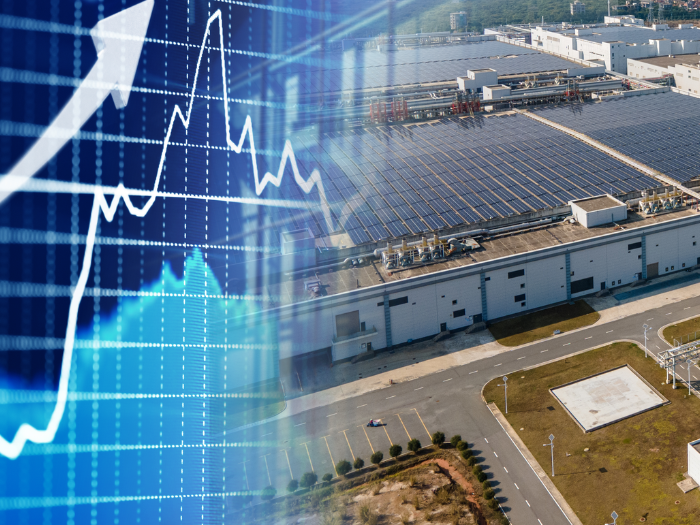
What is a distributed energy network, and why are businesses building their operations around one?
A distributed energy network turns batteries, on-site generation and flexible load into one co-ordinated, revenue-earning system. In this article we explore what that means, why the grid connection crisis is accelerating it, and why software now matters more than the hardware.
For decades, energy was something a business bought rather than managed. You picked a site, secured a grid connection, signed a supply contract and got on with running the operation. Power was a utility bill, not a strategy. But connection queues now stretch for years, network charges keep climbing, and wholesale prices bring significant volatility that’s challenging to account for. At the same time, the assets sitting on many sites are more controllable than ever. Put those two trends together and you get the distributed energy network: a way of running a site’s energy that treats every flexible asset as part of a single, intelligently managed system.
The grid can no longer be your only plan
The bottleneck often isn’t generation technology or capital; across every major market, demand for new connections has run far ahead of what networks can physically deliver, and regulators are responding by asking large users to bring flexibility, storage or generation with them.
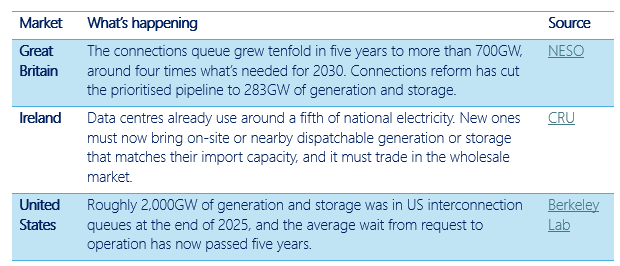
A connection date is no longer a planning assumption you can bank on. And where regulators do grant access, they increasingly expect the site to provide flexibility, firm capacity, and market participation.
What is a distributed energy network?
A distributed energy network is a set of energy assets located at or near the point of use (battery storage, on-site generation and/or flexible load) that are co-ordinated by software to act as a single system, working alongside the grid rather than instead of it. On their own, those assets are pieces of equipment. But when a single intelligence layer sees all of them at once and decides, minute by minute, what each should be doing, they become a network.
The four building blocks
Most distributed energy networks combine some or all of the following. The mix depends on the site, the load profile and the market it sits in:
- flexible load: this component is usually the cheapest to unlock. Industrial processes, HVAC, refrigeration, pumping, compressed air and EV charging can often shift or pause for short periods without affecting output. Every megawatt of load that can move on demand is one the grid doesn’t have to supply at peak, and one that markets will pay for
- energy storage: a battery energy storage system (BESS) charges when power is cheap or plentiful and discharges when it’s expensive or scarce. It reacts in milliseconds, which makes it ideal for frequency response and other fast ancillary services. Behind-the-meter, it can also cut peak demand charges and let a site run more load than its import capacity alone would allow
- on-site generation: solar PV, CHP and standby generators provide energy the site produces itself. Renewables lower costs and emissions, and dispatchable generation provides firm capacity, which grid operators reward
- the intelligence layer: this is the part that turns equipment into a network. An AI-driven platform monitors every asset, the site’s own needs, wholesale prices, grid signals and market opportunities in real time. It then decides what each asset should do, and when, to keep the site running and earn the most from every megawatt
Hardware sets the ceiling on what a distributed energy network can do. Software decides how close you get to that ceiling. A single battery or flexible load can earn from several markets, but rarely all at once, and the most valuable option changes by the hour. Committing capacity to frequency response might pay well this afternoon; tomorrow evening, wholesale arbitrage or a Balancing Mechanism dispatch could be worth more. Getting that call right, thousands of times a year, is what generates a strong return.
The intelligence layer forecasts, predicting site demand, prices and asset availability. It optimises, choosing the best combination of markets while respecting the site’s operational limits, production targets and throughput requirements. Then it executes, dispatching assets automatically and reliably enough to meet each market’s performance rules. The software has to know those boundaries and work inside them, every time.
Who is building one?
Any organisation with significant energy costs, flexible assets or a growth plan the grid can’t keep pace with is a candidate:
- energy-intensive industry: manufacturers, food and drink processors, water utilities and cold-chain operators often have more flexibility than they realise. Much of it sits in processes that already run on schedules. Bringing that load into a co-ordinated network cuts peak costs, creates new revenue and hedges against price volatility, usually with little or no capital spend
- data centres: batteries and back-up generation that data centres already need for resilience can earn when they aren’t protecting uptime, provided the control system respects the facility’s reliability requirements. In Ireland, on-site dispatchable capacity is now a condition of connecting at all. In the USA, “bring your own power” is becoming commonplace
- EV fleets and charging hubs: depot electrification can push a demand well beyond a site’s existing connection. Smart charging, paired with on-site storage, lets fleets charge more vehicles on the same supply and shifts consumption away from expensive peaks
- multi-site portfolios: retailers, logistics groups and property owners with dozens or hundreds of sites can treat their whole estate as one network. Individually, each site’s flexibility may be small. Aggregated and optimised centrally, it becomes a meaningful asset that can compete in markets built for much larger players
Once a site’s assets are co-ordinated by the same platform as thousands of others, they can be aggregated into a virtual power plant (VPP). To the grid operator, a VPP can be dispatched, relied upon and paid for the services it provides. That changes the relationship between businesses and the grid. Instead of queuing for capacity a site helps balance supply and demand, supports a system with more and more variable renewable generation, and earns for doing so. Storage and/or generation installed to cover a connection shortfall doesn’t lose its purpose once the full connection arrives. It keeps earning in different markets.
FAQs
Q: Is a distributed energy network the same as a microgrid?
A microgrid is usually designed to island, running independently of the main grid when needed. A distributed energy network may include that capability, but its main purpose is co-ordination and optimisation, and it normally operates connected to the grid.
Q: How is it different from a virtual power plant?
A distributed energy network describes the assets and control at a site or across a portfolio. A VPP is what you get when many of those networks are aggregated and traded together in energy markets. One feeds the other.
Q: Do I need to install new equipment?
Not always. Many organisations start with the flexibility already in their operations (existing load, backup generators or a battery) and add storage or generation later, once the business case is proven.
Q: Will it disrupt my operations?
A well-designed platform works within limits you set, so production, comfort and uptime always take priority over market participation.
Latest energy insights
-
7 October 2026
4 minute read
Private wires in Ireland: a new route to power for data centres and industry?
Read More -
7 October 2026
7 minute read
What is a distributed energy network, and why are businesses building their operations around one?
Read More -
25 September 2026
3 minute read
The age of electricity: the growing role of electricity in economies and energy systems
Read More -
 Awards
News
Awards
News
17 September 2026
2 minute read
GridBeyond named a Business Energy Achievement Awards winner for innovation in data centre energy flexibility
Read More -

17 September 2026
2 minute read
MPs call for removal of “net zero” from government terminology
Read More -
15 September 2026
4 minute read
What could Class A License Exempt Supply mean for your business?
Read More -

2 September 2026
3 minute read
Trust, by design: GridBeyond’s certifications and standards
Read More