News
better business decisions
Posted 1 month ago | 5 minute read

Ancillary services: explained
To operate a safe and secure power system, the National Energy System Operator (NESO) procures a suite of ancillary services through designated markets and via Bid Offer Acceptances (BOAs) in the Balancing Mechanism.
In this article we explore the range of ancillary services currently available and how the markets could change in the future.
What are ancillary services?
Ancillary services refer to functions that help grid operators maintain a reliable electricity system. Ancillary services include a wide variety of efficiency and safety nets; all focussed on ensuring the power system delivers enough output to meet demand yet remains stable.
NESO organises its procurement around eight core service categories: Frequency Response, Reserve, Stability, Reactive Power, Demand Flexibility, Thermal Constraints, and Restoration, all co-ordinated alongside the Balancing Mechanism. Each category serves a distinct technical purpose, and each is undergoing its own pace of reform.
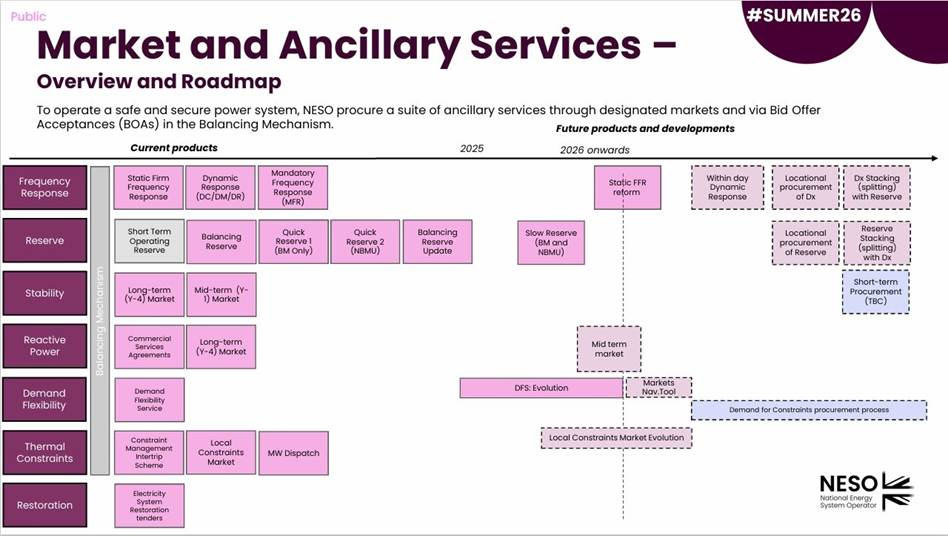
Source: NESO
Frequency response
The frequency within a power grid in the UK is 50 Hertz. Deviations outside of the range of 49.5Hz to 50.5Hz can damage equipment and/or cause failure of the grid. Frequency response either increases or decreases the amount of power on the network on a second-by-second basis so that supply and consumption are matched as closely as possible.
Products include Static Firm Frequency Response, Dynamic Response (split into DC, DM and DR variants depending on how quickly and for how long a resource must respond), and Mandatory Frequency Response (MFR), a long-standing obligation on larger generators.
Looking ahead, NESO is planning a shift to Static FFR reform and, further out, a Within-Day Dynamic Response product reflecting a broader push toward faster-acting, more granular response as renewable generation increases variability on the system.
Reserve
An important part of ancillary servicing is having back-up power to release if something unexpected happens. Reserve services provide the backup capacity NESO can call on when actual demand or generation deviates from forecast.
The current suite includes Short Term Operating Reserve, Balancing Reserve, Quick Reserve 1 (BM-only) and Quick Reserve 2 (NBMU for non-Balancing Mechanism units), plus a Balancing Reserve Update already in train. From 2025, Slow Reserve was introduced for both BM and NBMU participants, with locational procurement of Reserve and “reserve stacking” (allowing reserve to be combined with other services) following in the 2026-onwards horizon.
This stacking direction matters considerably for flexibility aggregators, since it signals NESO moving toward designs that let a single asset participate in multiple revenue streams simultaneously rather than being locked into one product.
Stability
Stability services aim to maintain system inertia and fault resistance as conventional synchronous generation retires. The current products are the Long-term (Y-4) Market and the Mid-term (Y-1) Market both auction-based, multi-year procurement routes.
This is one of the categories to watch closely, since as more thermal plant closes, the value of synthetic and rotating stability services is likely to increase.
Reactive power
Reactive Power services help manage voltage levels across the transmission network. NESO currently procures this through Commercial Services Agreements and the same Long-term (Y-4) Market structure used for Stability, with a Mid-term market under development.
Reactive power remains a relatively under-monetised service for many asset owners, but the direction of travel toward more structured, tradeable products should make it more accessible over time.
Demand flexibility
For many businesses this is often the most directly relevant category.
The current product is the Demand Flexibility Service (DFS), which pays consumers and aggregators to reduce demand at times of system stress.
DFS, as the primary means for non-Balancing Mechanism (BM) participants to provide flexibility for margin, has seen several changes, including a bi-directional element to support negative margin, locational procurement and reducing the minimum participation threshold to 0.1MW. The Local Constraint Market has been extended until at least January 2027.
The service increased its demand-side flexibility participation in 2025, following several changes to the services such as the Applicable Balancing Services Volume Data (ABSVD) opt out and asset metering rules. Operational Metering requirements in the Balancing Mechanism for aggregated assets smaller than 1 MW have been relaxed, and the operational metering derogation which allows up to 300 MW of aggregated assets to permanently participate in the BM is being retained
Wholesale and network price signals are essential for growing demand-side flexibility. Smart and advanced metering, alongside universal half hourly settlement, will enable consumers to access these signals and benefit from flexibility. Time of use tariffs remain the primary route for rewarding flexible behaviour, with Virtual Trading Party (VTP) participation emerging as an additional mechanism
Thermal constraints
Thermal Constraint management addresses situations where local parts of the network would otherwise be overloaded. Current tools include the Constraint Management Intertrip Scheme, the Local Constraints Market, and MW Dispatch.
In 2025, a Local Constraints Market Evolution project began, with a Demand for Constraints procurement process expected from 2026. As constraint costs on the system have risen (driven largely by the mismatch between renewable generation locations and demand centres) this is one of the fastest-moving areas of reform, and one where locational products are likely to create opportunities for flexible assets sited in constrained areas.
Restoration
Restoration services (procured through Electricity System Restoration tenders) ensure the system can recover from a total or partial blackout. This is a specialised, low-frequency category, and the roadmap shows no major structural change signalled for 2025-26, reflecting its already well-established procurement model.
Latest energy insights
-
15 October 2026
6 minute read
Following the forecast: the hidden risk in battery optimization | Q&A
Read More -
7 October 2026
4 minute read
Private wires in Ireland: a new route to power for data centres and industry?
Read More -
7 October 2026
7 minute read
What is a distributed energy network, and why are businesses building their operations around one?
Read More -
25 September 2026
3 minute read
The age of electricity: the growing role of electricity in economies and energy systems
Read More -
 Awards
News
Awards
News
17 September 2026
2 minute read
GridBeyond named a Business Energy Achievement Awards winner for innovation in data centre energy flexibility
Read More -

17 September 2026
2 minute read
MPs call for removal of “net zero” from government terminology
Read More