News
better business decisions
Posted 2 months ago | 3 minute read

Cutting curtailment: why flexibility and behind-the-meter storage matter
Our energy generation mix is changing and becoming increasingly dominated by renewable technologies.
According to the latest Energy Trends report (covering January to March 2026), renewable electricity generation rose 18% on year ago levels to hit a new record of 43.7TWh, and a share of 53.1% of generation in the first quarter of the year. Wind generation provided 35.6% of the total generation, outpacing the 32.3% provided by gas.
This is what the sector has spent a decade working towards. But the grid network wasn’t built for this much wind, this fast and when output surges the National Energy System Operator (NESO) is left with one option: switch the wind farms off, then pay gas plants, or imports, to make up the shortfall. This is known as curtailment, and it’s one of the biggest drivers of what it costs to balance Britain’s electricity system.
The last few years have seen considerable increases in balancing costs. The latest Annual Balancing Costs Report estimates that, balancing costs rose 10% in the 2024-25 financial year. The total cost of offers (generation being paid to turn up) has increased in 2024-25 by £222M. The total cost of bids (generation being paid to turn down) has increased in 2024-25 by £33M. This is primarily driven by an increase in the total volume of bids accepted and specifically a larger volume of bids accepted for wind. That share keeps climbing as more weather-driven generation comes online. NESO estimates that balancing costs will continue to rise in the short term, reaching a peak of ~£8B in 2030.
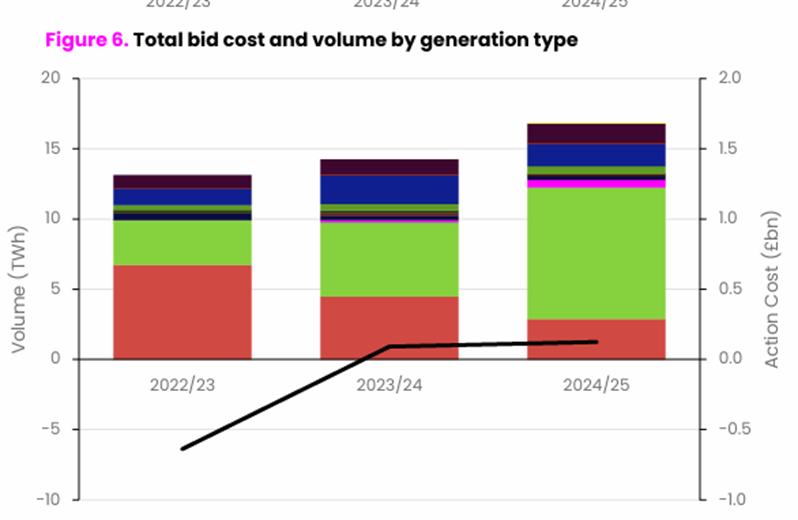
Source: NESO
New transmission lines take years to plan, consent and build. Shifting demand and storage output to match supply (rather than forcing supply to match demand) can be deployed much faster and it works with the grid we already have, not the one we might have in the future. That’s why demand response and behind-the-meter battery storage have become core infrastructure.
For businesses, on-site battery storage, installed behind the meter, lets a business pull less from the grid when it’s expensive and congested and get paid for offering that flexibility back to the system. Demand response does much the same job without the capital outlay: shifting or shedding load at the right moment, automatically, in step with grid signals and price movements.
Businesses with on-site generation, storage or flexible load can stack value across several revenue streams at once. But doing that well means reading real-time signals across multiple markets simultaneously, protecting battery health over the asset’s working life, and making split-second calls on when to charge, discharge, or simply hold. This is where having the right technology and trading expertise is crucial. At GridBeyond, our AI-driven optimisation platform reads market and system signals continuously, directing flexible assets to their highest-value use at any given moment, without shortening the asset’s life in the process.
As Britain’s grid gets greener and more constrained at the same time, that kind of active, intelligent flexibility becomes what keeps the whole transition affordable. GridBeyond’s smart trading solution combines machine learning, AI and data solvers with a trading team. We have long standing experience managing state of health and State of charge for battery assets, and significant investment in data science and accurate forecasting tools, our traders optimise all opportunities with high levels of confidence. This ensures that project owners maximise the value not only from the renewables project, but from the battery storage asset and associated demand flexibility.
Latest energy insights
-
15 October 2026
6 minute read
Following the forecast: the hidden risk in battery optimization | Q&A
Read More -
7 October 2026
4 minute read
Private wires in Ireland: a new route to power for data centres and industry?
Read More -

7 October 2026
7 minute read
What is a distributed energy network, and why are businesses building their operations around one?
Read More -
25 September 2026
3 minute read
The age of electricity: the growing role of electricity in economies and energy systems
Read More -
 Awards
News
Awards
News
17 September 2026
2 minute read
GridBeyond named a Business Energy Achievement Awards winner for innovation in data centre energy flexibility
Read More -

17 September 2026
2 minute read
MPs call for removal of “net zero” from government terminology
Read More