News
better business decisions
Posted 4 months ago | 3 minute read
Government seeks views on community battery plan
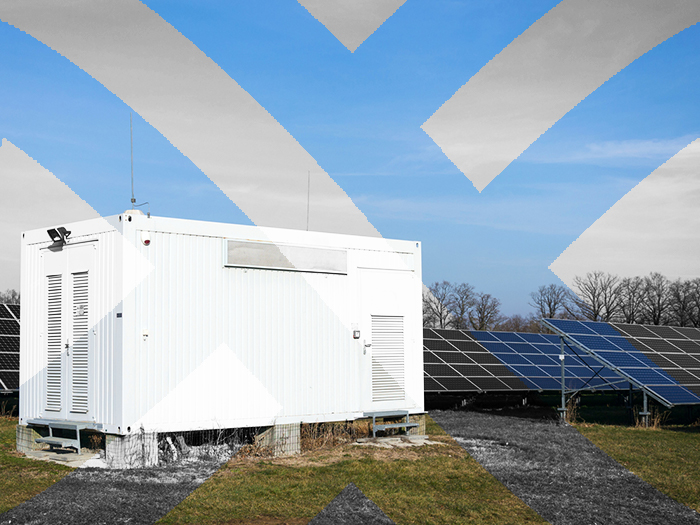
The government has unveiled new proposals to deploy community batteries, a strategic move designed to cut energy bills and store renewable power.
Published on 4 June the call for evidence notes that there are an estimated 1.6GWh of home batteries across ~299k households across Great Britain. The government’s £15B Warm Homes Plan will support further rollout and they are exempt from VAT until March 2027. But uptake faces challenges: many homes lack space for battery units, and upfront costs remain a barrier despite long-term savings. This means domestic storage cannot currently reach all households. Community batteries are an untapped source of storage with the potential to contribute to the flexibility capacity required for clean power by 2030 while reducing costs for consumers.
Energy Minister Michael Shanks said: “If households are going to feel the full benefit of clean power, we need a more flexible energy system and community batteries can help deliver it, giving renters and people living in flats the chance to store cheaper renewable electricity and cut their bills […] This is about putting power back into the hands of local people and ending our reliance on fossil fuel markets driving the affordability crisis; helping communities take control of their energy, build local wealth and restore pride in place”.
The government is seeking views on the potential benefits of community batteries, including lower energy bills, improved use of locally generated renewable electricity and greater access to energy storage for people who cannot install their own batteries. It aims to understand
- the economic case for community batteries, including installation costs, operating models, funding arrangements and how financial benefits are shared among participants
- regulatory, technical and commercial barriers that may be preventing wider deployment of community battery projects across the UK
- safety and governance and whether additional policy or regulatory measures are needed to support future growth of community energy storage
GridBeyond Director of Public Sector & Funded Assets, Phil Best, said:
“As batteries become an increasingly important part of the future energy system, it is essential that they are not viewed as standalone assets, but as part of a wider portfolio of flexible energy resources that can be coordinated to support both local communities and the wider electricity grid.
“By aggregating and optimising battery storage alongside other distributed energy assets, greater value can be unlocked through improved asset utilisation, enhanced grid stability and access to multiple revenue streams. With more than 5GW of assets under management globally and a proven track record in battery optimisation and grid services, GridBeyond believes community batteries have the potential to become active participants in the energy transition, delivering benefits for consumers, communities and the wider energy system alike.”
Responses to the call for evidence are invited before 30 July.
Latest energy insights
-
15 October 2026
6 minute read
Following the forecast: the hidden risk in battery optimization | Q&A
Read More -
7 October 2026
4 minute read
Private wires in Ireland: a new route to power for data centres and industry?
Read More -

7 October 2026
7 minute read
What is a distributed energy network, and why are businesses building their operations around one?
Read More -
25 September 2026
3 minute read
The age of electricity: the growing role of electricity in economies and energy systems
Read More -
 Awards
News
Awards
News
17 September 2026
2 minute read
GridBeyond named a Business Energy Achievement Awards winner for innovation in data centre energy flexibility
Read More -

17 September 2026
2 minute read
MPs call for removal of “net zero” from government terminology
Read More