News
better business decisions
Posted 1 month ago | 6 minute read
The complete guide to Energy Management Systems (EMS)
Learn what an Energy Management System is, how it differs from simple monitoring, why it is the control layer behind BESS and flexibility strategies, and how to choose the right one.
Every flexibility strategy, whether it is demand response, battery optimisation or a virtual power plant, depends on a layer of technology that most people never see directly: the Energy Management System (EMS).
The EMS is the software, and often the supporting hardware, that sits between a business’s physical energy assets and the decisions being made about how those assets should operate. Get it right, and every other flexibility initiative becomes possible. Get it wrong, or treat it as an afterthought, and even well-designed strategies struggle to deliver, because the control layer beneath them cannot see enough, or act fast enough, to execute what has been decided.
This guide explains what an EMS actually is, what distinguishes it from simple energy monitoring, and why it matters so much to the performance of battery storage, VPP and flexibility programmes.
What is an Energy Management System?
An Energy Management System is an integrated set of hardware, software and processes designed to monitor, control and optimise how electricity is used, generated or stored across a site, a portfolio of sites, or a single asset such as a battery.
At its simplest, an EMS collects data: from meters, sensors and connected equipment, in real time. At its most advanced, it goes much further, analysing that data, identifying inefficiencies, issuing alerts, and directly controlling connected assets in response to changing conditions, without a person in the loop for every decision.
This distinction matters. An energy monitoring system tells you what happened. An energy management system decides, and often acts on, what should happen next.
The components of an EMS
- sensors and meters: the device layer that measures electricity consumption, generation and storage in real time, down to circuit, asset or even cell level
- control systems: automated controls capable of adjusting HVAC, lighting, industrial processes, battery charge and discharge, or EV charging in response to signals
- analytics and software: the layer that interprets incoming data, identifies opportunities or risks, and generates the instructions sent to control systems
- communications and gateways: the protocols and infrastructure that allow all of the above to exchange data reliably, often across equipment from many different manufacturers
Together, these components form a closed loop. Data flows in, is analysed, and results in control decisions, which in turn generate new data. The tighter and faster this loop runs, the more responsive and valuable the EMS becomes.
Two different things called ‘EMS’
One of the most common sources of confusion when businesses evaluate energy management software is that the term covers two different types of product.
The first is a facility or enterprise EMS. Its buyer is typically an energy or sustainability manager. Its job is to meter consumption, surface waste, shave demand peaks, and support ESG and compliance reporting. This category is well served by off-the-shelf software.
The second is a grid-edge control layer. Its buyer is typically an aggregator, an asset owner, or an organisation that generates, stores or orchestrates energy, such as a business operating battery storage or participating in flexibility markets. Its job is to take live telemetry and forecasts to optimise and dispatch assets against market or grid signals, and settle the financial result.
These two products solve different problems, and the right choice depends on which question a business is actually trying to answer: simply, do you need to understand and reduce your energy use, or do you need to actively trade and dispatch flexible assets for commercial value?
EMS vs monitoring vs SCADA
These terms are often used loosely, but the distinctions matter when evaluating a system.
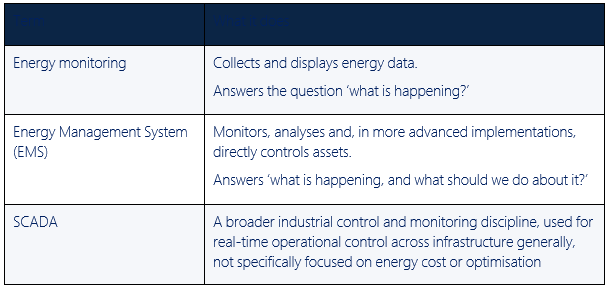
An EMS overlaps with both, but its defining focus is energy optimisation: reducing cost, improving efficiency and, increasingly, generating commercial value from flexibility, rather than operational control for its own sake.
Why EMS matters for battery storage, VPP and flexibility
A battery energy storage system is, on its own, just hardware. Cells, racks, inverters and a Power Conversion System capable of storing and releasing electricity. The EMS is the layer that decides when the battery should charge, when it should discharge, which market it should serve, and how hard it should be pushed, all while respecting the asset’s real-time state of charge, state of health and safety limits. The same is true for virtual power plants and demand response programmes. A VPP is only as good as the EMS co-ordinating the assets beneath it. A demand response commitment is only reliable if the EMS can verify, in real time, that the committed flexibility is actually available.
This is why EMS is often described as the control layer that everyone plans around but few plan for directly. Businesses frequently invest heavily in flexible hardware, batteries, on-site generation and EV chargers while treating the EMS co-ordinating it all as a secondary decision. The result is usually a system that can see its assets, but cannot make the fast, forecasting-led, multi-market decisions needed to extract full value from them.
Choosing the right EMS
For businesses with, or planning, flexible or storage assets, a small number of questions tend to separate systems that can genuinely support a commercial flexibility strategy from those that cannot:
- does it forecast, or only report on what has already happened?
- can it dispatch assets automatically, within safe technical limits, or does it require manual intervention for every action?
- is it hardware-agnostic, able to integrate assets from different manufacturers, or does it lock a business into a single vendor’s equipment?
- can it evaluate multiple markets simultaneously, or is it built around a single use case, such as bill reduction alone?
- does it account for asset-specific constraints, such as battery degradation or industrial process limits, when making dispatch decisions?
The answers to these questions determine whether an EMS is capable of supporting a genuine flexibility optimisation strategy, or whether it is better suited to monitoring and reporting alone.
Why GridBeyond’s approach to EMS is different
Many EMS products in the market were built for either facility-level monitoring and reporting, or narrow, single-asset control; GridBeyond’s Point Platform is built to answer both, as a single, integrated layer.
The platform combines real-time monitoring of every connected asset, whatever the manufacturer. With GridBeyond the same system responsible for understanding a business’s energy position is also responsible for optimising and dispatching it; continuously connecting forecasting, market evaluation and automated dispatch into one closed loop.
For organisations planning new battery storage or flexibility investment, GridBeyond’s Designer Studies also allow the EMS and optimisation strategy to be considered from the earliest stage of a project, rather than bolted on once hardware has already been specified and installed.
Latest energy insights
-
 News
Press Release
News
Press Release
20 August 2026
4 minute read
GridBeyond launches commercial optimization of 29.7 MW battery portfolio in ERCOT new co-optimized market
Read More -

29 July 2026
3 minute read
Cutting curtailment: why flexibility and behind-the-meter storage matter
Read More -

24 July 2026
11 minute read
Virtual Power Plant vs DERMS vs aggregation: what’s the difference?
Read More