News
better business decisions
Posted 4 months ago | 3 minute read

Why your BESS management stack might be costing you money
Battery energy storage systems have matured rapidly, but as the technology has scaled, so too has the complexity of managing it. Many asset owners have responded by assembling multi-vendor stacks, stitching together hardware providers, energy management systems, trading platforms and operational service providers. In practice, this often erodes performance and revenue over time.
Every additional vendor relationship introduces new latency and new ambiguity about who is responsible when something goes wrong. When a grid frequency event occurs, the system must detect the deviation at the hardware layer, interpret it at the controls layer, validate it against contracted service parameters, dispatch the asset and record the response, all within a window that may be measured in milliseconds. If those layers belong to different vendors operating on different software update cycles and different API versions, every handoff is a potential failure point. The difference between a qualified delivery and a non-delivery has direct consequences for availability payments and performance scores.
Beyond latency, fragmented architectures create accountability diffusion. When performance falls short, each vendor’s instinct is to demonstrate that the fault lies elsewhere in the stack. Nobody has full visibility, so nobody takes full ownership. Data quality also suffers: when sensor readings are collected by one system, processed by another and presented in a third, each translation step introduces the possibility of miscalibration.
A single-platform architecture addresses all of this by aligning responsibility with capability. GridBeyond has built its proposition around this principle. At the foundation is proprietary hardware, the TouchPoint device, designed specifically for grid edge operation with firmware and communication protocols developed in house. This eliminates adaptation layers and ensures consistent data quality from the point of capture.
The core platform integrates TouchPoint, Site Controller, CiteSee and Forecaster into a unified energy management system operating on a shared data model and synchronised timeframes. Market participation is delivered through bid optimisation and trading execution that sits directly within the same architecture rather than operating as a bolt-on third party service. Settlement records are captured within the same system that generated the dispatch instructions, reducing reconciliation effort and providing a clear audit trail.
GridBeyond also acts as scheduling entity and operates a network operations centre (NOC) providing round-the-clock monitoring and remote intervention. This means GridBeyond is not handing over a configured platform and stepping back. It is functioning as a full operational partner across the entire asset lifecycle, from hardware design and commissioning through to trading and settlement.
One counterparty means simpler contracts. One data source means resolvable disputes. One support organisation means clear escalation. For asset owners who want consistent performance at scale, the architecture is not a secondary consideration. It is the foundation everything else is built on.
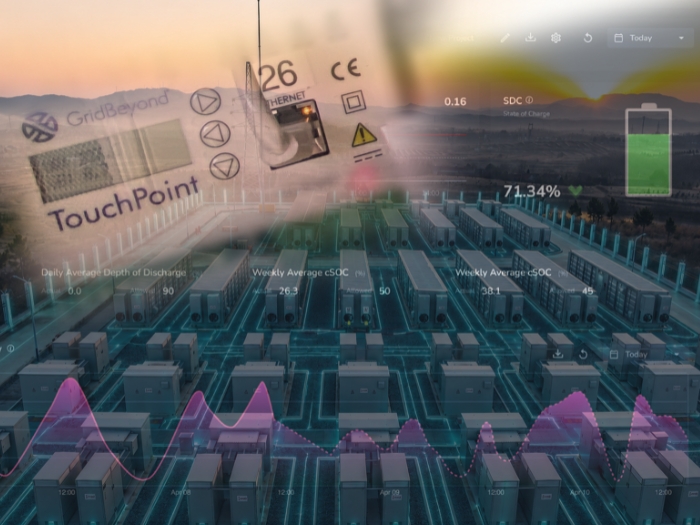
Whitepaper| From sensor to settlement | The value of single-platform BESS management
This white paper examines why that fragmentation imposes measurable costs on asset performance and revenue, and why a single-platform architecture represents not just a convenience but a structural advantage.
Learn moreLatest energy insights
-
15 October 2026
6 minute read
Following the forecast: the hidden risk in battery optimization | Q&A
Read More -
7 October 2026
4 minute read
Private wires in Ireland: a new route to power for data centres and industry?
Read More -

7 October 2026
7 minute read
What is a distributed energy network, and why are businesses building their operations around one?
Read More -
25 September 2026
3 minute read
The age of electricity: the growing role of electricity in economies and energy systems
Read More -
 Awards
News
Awards
News
17 September 2026
2 minute read
GridBeyond named a Business Energy Achievement Awards winner for innovation in data centre energy flexibility
Read More -

17 September 2026
2 minute read
MPs call for removal of “net zero” from government terminology
Read More