News
better business decisions
Posted 1 day ago | 2 minute read

Australia is off track for its renewable target, warns IEEFA
The Institute for Energy Economics and Financial Analysis (IEEFA) has warned that Australia is not on track to meet its 2030 renewable energy target, as too few large-scale projects are progressing to construction. But it identifies industrial and commercial solar and storage, along with residential flexibility, as demand-side resources that could help close the gap.
In a fact sheet published on 19 October, IEEFA said the development pipeline holds more than enough wind, solar and battery capacity to meet the 2030 targets, including around 45.7GW of solar and 42.2GW of wind on the main grid. But the capacity under construction falls well short of what is required. It cited the shortage of projects with power purchase agreements (PPAs) as a key obstacle, alongside approval delays for wind projects and solar projects stalling after approval. Many projects awarded Capacity Investment Scheme support also remain at an early stage. Moving approved projects into construction would deliver 127,000 job-years of construction work and $44B in investment.
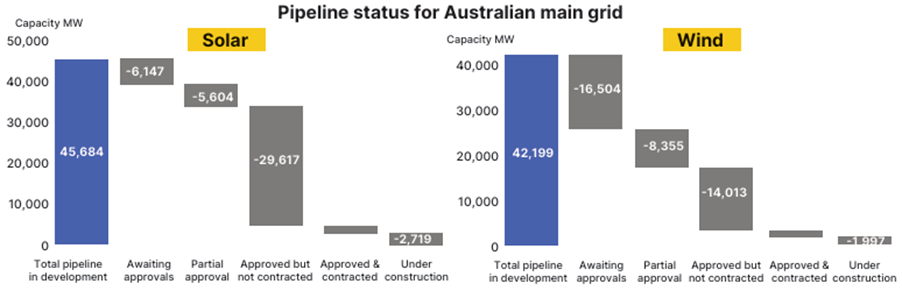
Source: IEEFA
Installed industrial and commercial solar capacity was noted at 5.6GW, with 17-31GW forecast by 2050, and IEEFA said the technical rooftop potential could be higher still. While the government has recently extended financial incentives to mid-sized solar systems, barriers remain, including complex and inconsistent network tariffs, slow and unpredictable grid connection processes, and an uneven playing field for network services provided by distributed energy resources (DER). IEEFA recommended reviewing and standardising network tariffs, streamlining grid connections and an independently led, first-principles review of the economic regulation of distribution networks, supported by a long-term policy framework for power sector decarbonisation or targeted business solar and storage incentives.
Rooftop solar and household battery installations reached record levels in the second quarter of 2026, but IEEFA said residential flexibility remains largely untapped. Solar sharer tariffs offering free electricity in the middle of the day could save consumers hundreds or thousands of dollars a year if combined with load shifting, while plug-in batteries could deliver savings for apartment residents without solar if regulatory barriers were removed. Premium evening feed-in tariffs could also encourage home batteries to export more to the grid, and incentives for demand flexibility and thermal efficiency could help reduce peak demand.
Latest energy insights
-

20 October 2026
6 minute read
Choosing a demand response or battery optimisation partner: 10 questions to ask before you sign
Read More -
15 October 2026
6 minute read
Following the forecast: the hidden risk in battery optimization | Q&A
Read More -
7 October 2026
4 minute read
Private wires in Ireland: a new route to power for data centres and industry?
Read More -

7 October 2026
7 minute read
What is a distributed energy network, and why are businesses building their operations around one?
Read More -
25 September 2026
3 minute read
The age of electricity: the growing role of electricity in economies and energy systems
Read More -
 Awards
News
17 September 2026
2 minute read
GridBeyond named a Business Energy Achievement Awards winner for innovation in data centre energy flexibility
Read More