News
better business decisions
Posted 10 hours ago | 4 minute read

Savings or grid services? Your battery can do both
Most on site batteries are bought to charge when power is cheap, discharge through the expensive red band hours and shave peaks off your demand. For the rest of the time, the battery is often sitting there, fully charged or half empty, earning nothing. That idle capacity is where grid services come in.
In this article we explore how a behind the meter battery can allow your business to earn from grid services at the same time as cutting peak costs.
Why so many batteries are sold without grid services
Selling and installing a battery is a hardware job, but earning from grid services is a trading and operations job. It needs forecasting, market access, metering that meets system operator standards and someone watching the asset around the clock. Many battery providers don’t have that capability in house. So, they sell on the savings they can model with confidence and leave the grid revenue out of the conversation. Some will mention it as a future option without saying who would deliver it or how. The result is a battery that’s specified, financed and installed to do half the job it is technically able to do.
How savings and grid services work together
Grid services only use the capacity and the hours your site doesn’t need. An optimisation platform, such as GridBeyond, makes that call every day and keeps making it as conditions change:
- protect the savings: it forecasts your site’s demand and your tariff, then reserves the battery for peak shaving, red band avoidance and any backup you need
- find the headroom: it works out which hours and how many megawatts are genuinely spare once your own needs are covered
- put the headroom to work: it offers that spare capacity into the grid services that pay best for those hours, within the limits you’ve set
This is what is meant by revenue stacking. The savings and the grid income sit on top of each other.
Which grid services a battery behind the meter can reach
A battery on your site can take part in most of the same markets as a grid scale battery, usually through an aggregator.
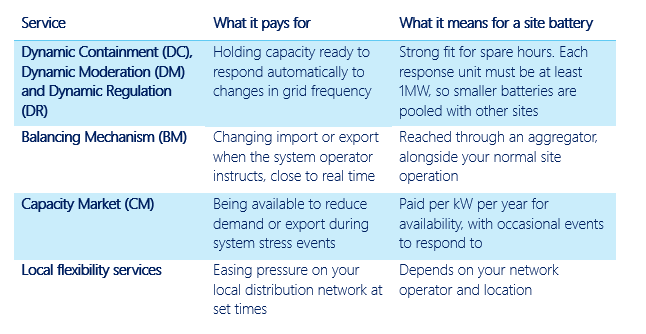
The rules for combining these services do change. Ofgem approved updates to the Dynamic Response terms in July 2026, including tighter stacking requirements and further changes from January 2027 for providers outside the Balancing Mechanism. Keeping on top of that is part of the job your optimisation partner should be doing for you.
What a stacked day looks like
Take an manufacturing site with a battery sized for peak shaving. On a typical weekday, the same battery might work like this:
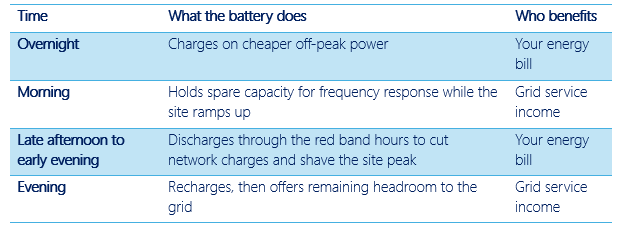
Without grid services, the morning and evening rows would simply be idle time.
Questions to ask before you sign
If you’re buying a battery, or already have one, these questions will tell you whether it’s set up to do everything it could:
- which grid services can this battery take part in, and who will operate it in those markets?
- how will my site’s savings be protected when the battery is earning from the grid?
- what control do I keep over capacity, hours and backup reserve?
- how is battery wear managed within the warranty?
- what does the metering need to look like, and is it included?
- how is grid income shared, and what are the contract terms?
If the answers are vague, the grid revenue probably isn’t part of the plan.
How GridBeyond helps
GridBeyond’s platform optimises batteries behind the meter for site savings and grid services together. It forecasts your demand and the markets, sets your site’s needs first, then trades the spare capacity across the services available to you. We work with batteries you already own and with new installations.
If your battery was sold on savings alone, it’s worth finding out what else it could be doing.
Latest energy insights
-

20 October 2026
6 minute read
Choosing a demand response or battery optimisation partner: 10 questions to ask before you sign
Read More -
15 October 2026
6 minute read
Following the forecast: the hidden risk in battery optimization | Q&A
Read More -
7 October 2026
4 minute read
Private wires in Ireland: a new route to power for data centres and industry?
Read More -

7 October 2026
7 minute read
What is a distributed energy network, and why are businesses building their operations around one?
Read More -
25 September 2026
3 minute read
The age of electricity: the growing role of electricity in economies and energy systems
Read More