News
better business decisions
Posted 15 hours ago | 4 minute read
Britain’s electricity supplies expected to remain secure this winter
This Winter could see a margin of 5.9GW, equivalent to around 9.5% above peak demand, according to NESO’s Winter Outlook for 2026-27.
Published on 26 October the document notes that margins will be adequate, within the Reliability Standard and comparable to recent winters. The base case de-rated margin for winter 2026-27 is 5.9GW (equivalent to 9.5% of average cold spell (ACS) peak demand), with an associated loss of load expectation (LOLE) of less than 0.1 hours per year. This remains in line with margins forecast in recent winters. Year-on-year, an increase in forecast peak demand has been largely offset by new capacity across a range of technologies, including battery storage, gas-fired power generation and wind generation.
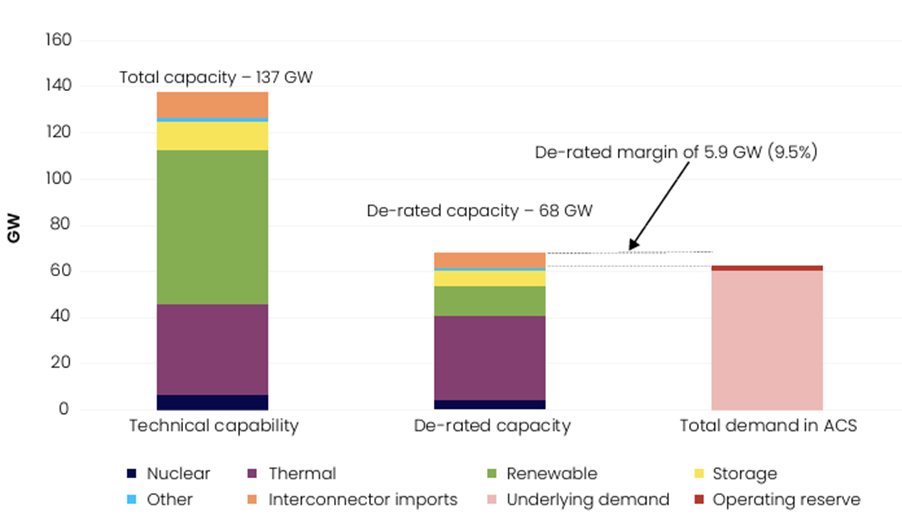
Source: NESO
The report also notes that ongoing conflict in the Middle East is causing constraints on liquefied natural gas (LNG) flows through the Strait of Hormuz. This disruption, combined with lower than-normal European gas storage at the start of winter has resulted in elevated gas and power prices. Fundamental differences in European power markets, together with structural changes in European gas markets, mean that prices, while above pre-conflict levels, remain below the highs seen in 2022 following the onset of conflict in Ukraine. However, uncertainties remain, including the duration of the effective closure of the Strait of Hormuz, how long production will take to return to pre-conflict levels and global weather patterns, including the ongoing impact of El Niño.
Frequently asked questions
What does the Winter Outlook say about electricity supply this winter?
NESO’s Winter Outlook expects Great Britain’s electricity supply to stay within the government’s Reliability Standard. Margins should look much like they have in recent winters. Peak demand is set to climb, but new capacity across a mix of technologies largely offsets that increase.
How is NESO getting ready for winter?
NESO plans for a broad spread of scenarios, working alongside government, Ofgem, the Met Office, National Gas, network operators, industry and partners overseas. It keeps a close eye on markets and weather forecasts, coordinates emergency planning and checks that its operational tools are ready to use.
What if supply margins get tighter?
Blackouts aren’t expected. As with every winter, some days may have less headroom than others. When that happens, NESO can draw on its standard operational tools to balance the system and keep power reaching homes and businesses.
What’s a “tight day”?
It’s a day when there’s less spare electricity than normal. It doesn’t mean supply falls short of demand. On these days, NESO may send the market a notice asking for more power to be made available, which helps it build up a bigger reserve. These notices are a routine part of running the system, and NESO prepares for them every year.
How much will imports from Europe matter?
Power from neighbouring countries is one strand of Great Britain’s varied supply mix. NESO’s analysis suggests imports should be there when they’re needed, and it works with neighbouring system operators to manage the flow of electricity between connected grids.
What’s the key takeaway for households and businesses?
The electricity system is secure, resilient and ready for winter. NESO’s assessment shows there should be enough electricity to cover demand, and it has proven tools and plans in place for any days when margins narrow.
Key terms
- de-rated margin: the spare electricity expected over winter, adjusted for how dependably each type of generation is likely to perform.
- operational surplus: a day-by-day view of spare capacity, which shows when tighter days might occur.
- LOLE (loss of load expectation): a measure of how often supply could fall short of demand. In practice, these shortfalls are usually handled through operational actions with no impact on customers.
- interconnectors: cables linking Great Britain to other countries, allowing electricity to be imported or exported as needed.
Latest energy insights
-
26 October 2026
4 minute read
Britain’s electricity supplies expected to remain secure this winter
Read More -

20 October 2026
6 minute read
Choosing a demand response or battery optimisation partner: 10 questions to ask before you sign
Read More -
15 October 2026
6 minute read
Following the forecast: the hidden risk in battery optimization | Q&A
Read More -
7 October 2026
4 minute read
Private wires in Ireland: a new route to power for data centres and industry?
Read More