News
better business decisions
Posted 1 month ago | 15 minute read

Beyond dispatch | Preserving battery value in competitive markets
The U.S. battery storage market is expanding rapidly, but operational misalignment between trading, controls, and warranty management is eroding asset value. This whitepaper explores key challenges facing storage owners and operators today and how real-time, state-aware optimization can restore alignment between physical performance and financial outcomes.
The growth of utility-scale battery energy storage systems (BESS) in the United States has been rapid. In the second quarter of this year, the U.S. deployed 4.9GW and 15GWh of utility-scale storage, representing a 63% increase compared to the same period in 2024. Wood Mackenzie expects cumulative installations across all segments to reach 88GW and 281GWh over the next five years. But with this expansion comes more competition. Projects are expected to meet availability targets, fulfil grid and market obligations, and manage long-term performance
under warranties and degradation curves. Those that can do this consistently stand to perform well. Those that cannot, may see underperformance, financial strain, or early end-of-life outcomes.
This whitepaper explores how real-time, state-aware optimization can restore alignment between physical performance and financial
outcomes. It captures three key challenges facing storage owners and operators today, and together with our webinar partner LG
Energy Solution Vertech, we share how
- degradation is controlled through dispatch behavior
- dispatch behavior is governed by market strategy
- market strategy is only as effective as the operator’s access to real-time system state and ISO interaction
If those functions live in different organizations, the asset does not have a coherent operating identity. It behaves like a set of arts, however, when they are integrated, the asset behaves like a single instrument tuned to both market and physical reality. That is the difference between an asset that only participates in the market and one that survives the market.
The challenge of faster-than-expected battery degradation
Battery degradation refers to the loss of usable capacity over time. It is not a single phenomenon but the cumulative result of electrochemical, thermal, and operational stress factors interacting over time. While it is often summarized as calendar fade and cycle fade, the real impact on system performance comes from how these mechanisms compound under real-world dispatch, environmental conditions, and control system decisions.
Even in a fully idle state, batteries experience calendar fade driven by side reactions that reduce lithium inventory. That baseline trajectory is typically known at commissioning. The problem arises when actual operating behavior pushes the system outside the boundaries assumed in the warranty or valuation model. The complexity grows at scale.
A utility-scale system may contain millions of cells arranged in modules, racks, and containers. If the distribution of aging is uneven, referred to as asymmetrical or non-uniform aging, the usable capacity of the entire system is limited by the weakest rack or module, not the average condition. Once divergence appears, it is difficult and expensive to reverse.
Temperature is a primary driver of this divergence. Container-level thermal gradients, HVAC control tuning, airflow obstruction, and even site layout can create rack-to-rack temperature variation. When cell groups operate at sustained temperature differences, they age at different rates, causing imbalance between packs. Imbalance forces derating to maintain safety margins, presenting to the operator as “unexpectedly fast degradation”, even if the fundamental materials are aging within predicted ranges. What shifts degradation from known and modeled to unexpected and financially material is a change in usage profile after commissioning.
In many systems, batteries are expected to remain in operation until capacity reaches roughly 60% of original energy. However, real operating behavior can accelerate the decline.
- Higher average state of charge: systems resting at high State of Charge (SOC), especially in markets where reserve capacity must remain available, see accelerated side reactions compared to systems that cycle around mid-SoC
- Wider depth of discharge ranges: frequent movement across large SoC windows increases mechanical and chemical stress. This was noted directly in the webinar: the same nameplate system can age at very different rates purely due to
dispatch profile - Aggressive cycling to chase short-term revenue: when operators chase real-time revenue without incorporating degradation cost into the bid logic, the fastest-value time periods can align with the fastest-aging cycling regimes. The revenue is real, but so is the accelerated path to capacity loss
- Operational vs. contractual profiles: the 10-year warranty degradation trajectory mentioned in the webinar was based on a modeled use case. The actual dispatch pattern being applied would result in an end-of-life nearer year seven if continued. Nothing “failed” physically; the system was simply operated differently than assumed in the contractual profile. This may be an intentional trade if the owner has already recovered investment or is prioritizing near-term revenue, but in other cases, it is a blind spot that affects long-term value
To address this, LG Energy Solution Vertech uses cloud-based monitoring tools to compare how systems are being used against original assumptions and warranty guidelines. These tools allow owners to see degradation trends as they develop. GridBeyond incorporates degradation awareness into market optimization. By including the “cost” of degradation in bid strategy, its system can identify when certain market actions may deliver small gains today at the expense of useful battery life later. This helps operators preserve state of health (SoH) during
times of low market pricing, with the aim of benefiting later when conditions improve.
We are not treating degradation as a fixed curve, but as something that can be managed operationally and our message for
sophisticated owners is:
“The most valuable storage systems over the next decade will not simply be the ones with the best cells, but the ones where dispatch behavior, thermal conditions, and warranty expectations remain aligned with continuous feedback, not periodic reviews.”
When project valuation does not match operational reality
Many storage projects built in the last development cycle were financed on revenue expectations that assumed consistent volatility and strong spreads across energy and ancillary markets. The expectation was that merchant income would be sufficient to support leverage and still leave meaningful upside. In some cases, that held. In many cases, it did not.
The gap did not come from misunderstanding the technology. It came from assuming operational and market conditions would behave like the base case.
Two issues tend to show up first when these assumptions break:
- revenue profiles flattening faster than expected: in certain regions, market prices and ancillary service compensation softened at the same time that competitive storage capacity increased. Systems that were modeled to operate near the
top of the supply stack now find themselves operating at the margin. Revenue declines, but the fixed obligations tied to
financing do not - operating strategies drifting from modeled behavior: when revenue is lower than forecast, trading behavior often becomes more aggressive as operators try to make up the difference. That can mean deeper cycling, higher average SoC, or more frequent use of fast-response modes. Those changes can accelerate capacity fade and reduce roundtrip efficiency. That loss of usable capacity reduces revenue further, creating a feedback loop where chasing near-term income erodes long-term earning power
This is where distress starts to appear because the project is still technically operating, but the value case that justified the capital stack is no longer intact. The system is not “failing,” but its economics no longer match its financing assumptions. Dr. Ali Kamiranian, GridBeyond’s head of optimization, is seeing real operators facing this scenario now. The details vary, but the pattern is consistent
- debt service is sized for modeled revenue, not actual revenue
- operating conditions are materially different from modeled assumptions
- the path to improvement requires operational, not financial, intervention
Chasing short-term revenue through aggressive cycling accelerates degradation and can erode long-term value. True recovery lies not in refinancing or restructuring, but in restoring operational discipline and realigning dispatch behavior, market participation, and asset health with the parameters that originally defined the project’s value. By addressing these issues operationally, owners can stabilize
returns, preserve capacity, and extend the economic life of their assets.
The value of state-aware marginal cost optimization
At this point, “optimization” can no longer mean simply bidding for the next available spread. Asset owners need to re-establish discipline, so that every dispatch decision is grounded in the actual state of the battery, not in a spreadsheet assumption. This is where GridBeyond’s proprietary SoC/SoH-aware marginal cost bidding changes the outcome.
Accurate SoH measurement (capacity boundary) and accurate SoC estimation (position within that boundary) provide the constraint surface on which rational economic dispatch can occur. When these signals are real, not inferred, the system can draw a line between bids that make sense and bids that eat away at project value.
SoH (usable capacity) determination using Differential Voltage Analysis (DVA) identifies electrode slippage and the limiting electrode in real time. The optimizer is not guessing where the effective capacity boundary is right now, not six months ago. Meanwhile SoC estimation using Extended Kalman Filtering (EKF) reconciles modeled vs. measured voltage under dynamic load. This prevents drift, avoids false headroom assumptions, and
provides a reliable, real-time indicator of where the system can move next, without breaching limits.
Augmentation deferral as a financial benefit The U.S. Energy Information Administration’s Annual Energy Outlook 2025 lists capital costs for utility-scale Li-ion systems at approximately $300/kWh. For a 100MW/400 MWh project, this corresponds to an initial capital investment of ~$120M. Typical planning assumes augmentation in years 5–7 to restore capacity lost to degradation. A 20–25% augmentation at current
cost levels represents $24–30 million of reinvestment. If SoC/SoH-aware dispatch strategies reduce avoidable degradation and defer augmentation by 3–5 years, the net present value of that reinvestment falls by ~25–40% depending on financing structure and discount rate.
That corresponds to preservation of roughly $6–12M in project value, driven not by revenue upside but by avoided premature capital expenditure.
Value is preserved not by extracting more cycles, but by cycling only when the market value exceeds the real marginal cost of wear.
These signals feed directly into dispatch logic; not as monitoring overlays, but as live parameters in bid formation. GridBeyond’s optimizer can therefore:
- dynamically adjust SoC guard bands to maintain operation inside the effective (not nameplate) energy window
- assign a marginal degradation cost to each prospective cycle, based on the current SoH trajectory, chemistry, and depth- of-discharge sensitivity
- permit explicit override behavior during scarcity events, with every override logged as intentional capital consumption
The result is a structural change in operating behavior:
- the system stops cycling for revenue that does not justify its wear
- the battery remains aligned with the life curve assumed in financing and warranty models
- the operator has the option, not the obligation, to exercise the asset harder when the market compensates accordingly
In this way, the operator moves from chasing transient gains to managing a durable, optimized asset that is capable of delivering both immediate returns and long-term stability across the full duration of its operational life.
Restoring alignment
Once a storage asset reaches operational/financial distress, there are only a few ways to recover value:
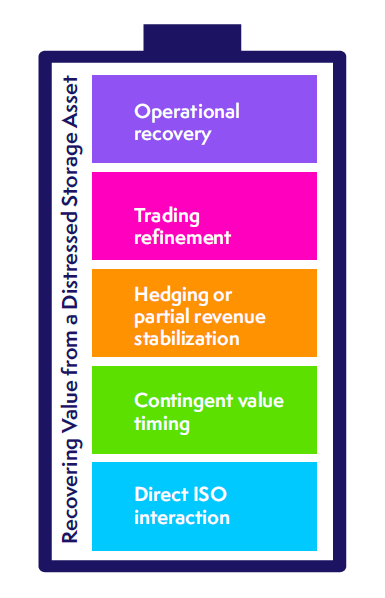
- Operational recovery: improve dispatch discipline. Reduce unnecessary cycle depth. Re-center resting SoC. Correct thermal imbalance if present. The goal is not theoretical optimization; it is to stop accelerating degradation while maintaining participation in the market
- Trading refinement: refocus bidding to capture reliable spreads rather than irregular spikes: Many distressed systems are not losing money because spreads disappeared; they are losing money because the bidding strategy is not aligned with
the asset’s actual efficiency and health state - Hedging or partial revenue stabilization: not every owner wants to hedge, but for systems already in distress, smoothing revenue swings can prevent further operational overreaction.
- Contingent value timing: this is the point GridBeyond emphasized directly: if the market is temporarily weak, preserving battery life until volatility returns can be more valuable than maximizing revenue in a suppressed period. This requires a trading engine that recognizes degradation cost, because without that input, short-term revenue will always appear to be the optimal choice on paper.
- Direct ISO interaction: when dispatch, settlement, or outage issues occur, delays add cost. If your trading desk cannot communicate directly with the ISO, you are effectively waiting in line to lose money. Integrated market participation matters for that reason, because it prevents avoidable downtime
The truth is that most distressed energy storage assets do not require restructuring. They require the operating behavior of the
system to be brought back in alignment with the assumptions that supported the financing in the first place. The longer that misalignment goes uncorrected, the more expensive the correction becomes.
The goal isn’t to chase the last marginal dollar the market offers. It’s to correct the fundamental drift between the operating profile the asset was designed, financed, and warranted around and the way it is being run. When those diverge, degradation accelerates, availability declines, and revenue becomes reactive rather than strategic. The value comes from getting the system back into alignment with its original operating envelope, then making deliberate decisions about when, and how, to step outside of it.
The case for co-ordinated control and trading
A storage asset is typically managed through a distributed vendor model:
- another monitors performance or system health
- one group controls the trading strategy
- another manages battery controls
- another communicates with the grid operator
This structure was common in the first wave of U.S. storage development, particularly when developers specialized in financing and project origination but relied on outside firms for operations. The issue with this model is that it does not handle variance, and the value of a storage asset is determined by how it performs under variance, not under ideal conditions.
An experienced operator knows the critical moments are not when markets are stable and systems are healthy. The critical moments are when:
- forecasts diverge from real-time conditions
- an HVAC subsystem drifts outside control limits
- ancillary services participation is suspended due to telemetry/data issues
- a unit is operationally available but not recognized correctly by the ISO
- bids are submitted but fail to clear due to a documentation or qualification mismatch
In those moments, an operator either fixes the issue in minutes or loses revenue and state of health value in hours. When functions are split across multiple entities, the failure mode is predictable:
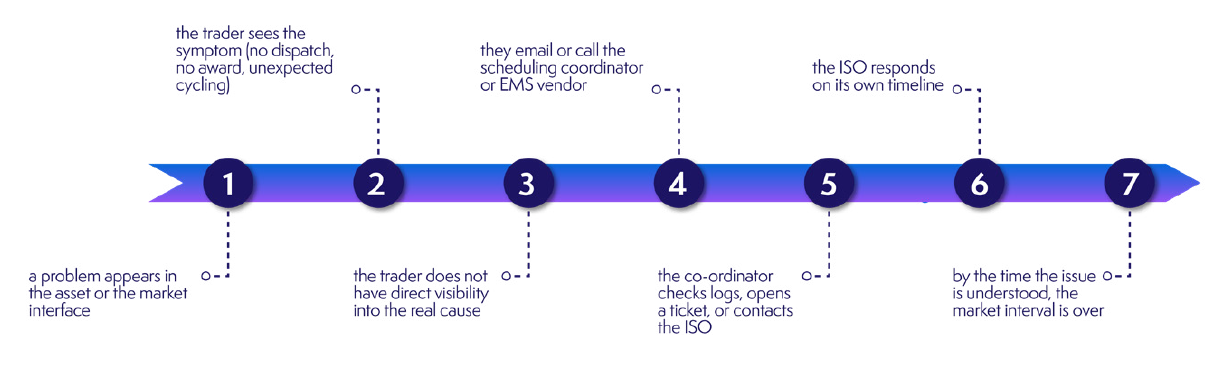
This is how assets that are technically functional underperform financially without experiencing any obvious “failures.” By contrast, working with GridBeyond collapses that chain of dependency. GridBeyond acts as a qualified scheduling entity and can communicate directly with grid operators. Our optimization, forecasting, control, and market execution are integrated, allowing for real-time adjustments and reducing the delays that occur when responsibilities are fragmented across multiple firms.
- forecasting, bid optimization, real-time control, and ISO communications are executed by the same entity
- the trading desk has direct authority to adjust dispatch and communicate with grid operators when needed
- data scientists and energy management system (EMS) engineers are internal rather than external contractors, so troubleshooting occurs inside the same workflow that executes trades
This means that discrepancies between forecast and actual system behavior can be corrected while the market window is still open. If a bid is rejected due to a qualification or telemetry issue, the scheduling co-ordinator does not need an intermediary. They resolve it directly with the ISO. If degradation risk increases, the optimizer can immediately modify bidding parameters rather than waiting for a monthly asset review.
Bringing trading strategy, forecasting, controls, and performance management under one co-ordinated framework can simplify accountability and support stronger asset outcomes.
Conclusion
The expansion of battery energy storage in the U.S marks a pivotal moment for the power sector, but it also exposes a new layer of operational and financial risk. As competition intensifies, the defining factor separating high-performing assets from underperforming ones is not just technology but how effectively owners align operational behavior, market participation, and degradation management.
Degradation is not a fixed trajectory but an operational variable that can be actively managed. While the electrochemical foundations of aging are well understood, the rate and financial impact of degradation depend heavily on dispatch behavior. Systems that cycle aggressively to capture short-term revenue age more rapidly than their modeled assumptions predict.
By incorporating degradation awareness directly into market optimization, asset owners can preserve usable capacity, extend augmentation timelines, and maintain warranty alignment all while continuing to participate profitably in the market. The resilience of an energy storage project depends on its ability to remain in alignment with its original valuation and financing assumptions. In the past assets were modeled on revenue profiles that assumed persistent volatility and wide spreads across markets. When those spreads narrowed, operators often reacted by cycling harder to recover lost revenue, unintentionally accelerating degradation and eroding long-term value. Real-time state awareness of both the battery’s condition and of its market position is essential to informed decision-making. With accurate, dynamic feedback, systems can recognize when market actions would deliver limited upside at disproportionate cost to useful life. This transforms optimization from a reactive process to a proactive, data-driven discipline.
When forecasting, trading, control, and performance monitoring reside with separate entities, even small variances can cascade into material losses. An operator who lacks visibility into real-time system state or must rely on intermediaries to interact with the ISO risks losing both revenue and battery health value in the time it takes to co-ordinate a response. By unifying these functions under a single accountable framework, battery owners and operators can eliminate delay, ensure consistent objectives, and create a feedback loop that keeps the asset operating within its intended life curve.
The lesson is clear: profitability cannot come at the expense of health. A disciplined approach, where every dispatch is informed by the true marginal cost of wear, preserves capital value and avoids the feedback loop of short-term gain leading to long-term decline. When degradation, dispatch, and trading strategy are managed as interconnected elements of a single system, energy storage ceases to be a passive participant in the market and becomes an active, adaptive instrument capable of surviving and thriving in it.
Latest energy insights
-

7 October 2026
4 minute read
Private wires in Ireland: a new route to power for data centres and industry?
Read More -

7 October 2026
7 minute read
What is a distributed energy network, and why are businesses building their operations around one?
Read More -

25 September 2026
3 minute read
The age of electricity: the growing role of electricity in economies and energy systems
Read More -
 Awards
News
17 September 2026
2 minute read
GridBeyond named a Business Energy Achievement Awards winner for innovation in data centre energy flexibility
Read More -

17 September 2026
2 minute read
MPs call for removal of “net zero” from government terminology
Read More -

15 September 2026
4 minute read
What could Class A License Exempt Supply mean for your business?
Read More