News
better business decisions
Posted 3 weeks ago | 4 minute read
PJM alerts…explained
To manage supply and demand through extreme heat, cold snaps and other severe weather, PJM works through a set of emergency procedures defined in its operating manuals and aligned with North American Electric Reliability Corporation (NERC) standards.
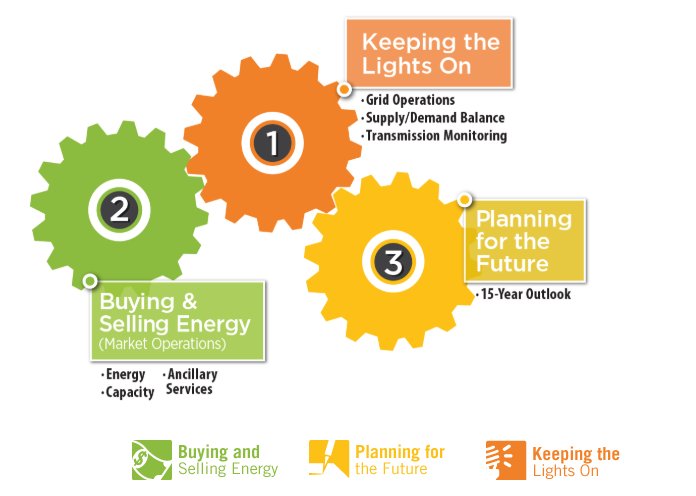
PJM’s three priorities are: keeping the lights on, administering the buying and selling of electricity through wholesale electricity markets, and assessing and planning for the future
needs of the electric grid.
Source: PJM
Weather-related messages
PJM issues a Cold Weather Advisory two to five days ahead of significantly cold weather, giving generation owners time to report on their availability and any operating limitations. This can be followed by a Cold Weather Alert one to two days ahead of significantly cold weather, prompting generator owners to prepare. Similarly Hot Weather Alerts are issued one to two days ahead of forecast 90°F-plus temperatures and/or high humidity, to prepare transmission and generation personnel and facilities for the surge in demand.
Capacity-related messages
Capacity Advisory was added to PJM’s emergency procedures in 2026, this gives up to five days’ notice of times when available generation is forecast to approach the demand requirement, even outside of extreme hot or cold periods.
Maximum Generation Alert can be issued a day in advance of conditions that may require all generators to run at maximum output, prompting them to defer or cancel any maintenance so units stay available. PJM issues a Load Management Alert alongside it, giving advance notice that demand response resources may be called on. This corresponds to a NERC EEA-1 (the first level of NERC’s Energy Emergency Alert framework), which is declared when a grid operator foresees, or is experiencing, conditions where all available resources are committed to load, firm transactions and reserve commitments, and sustaining contingency reserves is a concern.
Voltage Reduction Alerts are issued when PJM forecasts that its operating reserve will fall below the required synchronized reserve level. A public appeal to all electricity customers to conserve power typically follows (issued 12 to 15 hours ahead of the effective period). This corresponds to a NERC EEA-2, declared when a grid operator can no longer meet expected energy requirements but can still maintain minimum contingency reserves.
Voltage Reduction Action, is actual voltage reduction on the distribution system, which PJM estimates can save 1,700MW-2,000MW of demand depending on the season, with effects generally unnoticeable to customers and equipment. This also falls within a NERC EEA-2.
Rotating Customer Outages are a last resort, implemented once all other means of supplying load have been exhausted. PJM directs system operators to shed a specified amount of load, sharing limited supply across customer groups through rotating outages. This is PJM’s implementation of a NERC EEA-3, which is declared when a grid operator can no longer maintain minimum contingency reserves and has implemented, or is about to implement, service interruptions to firm load.
Looking ahead
NERC’s latest resource adequacy assessment for PJM said demand for electricity is growing at its fastest pace in years, driven primarily by data centers, followed by electrification and manufacturing loads. PJM summer peak demand is expected to grow by 56GW to a total of 210GW in 2035, and its winter peak demand is expected to reach 198 GW by winter 2034-35. PJM’s annual net energy for load growth rate is projected to average 4.8% per year over the next 10 years, up from 2.3% in last year’s projections. At the same time, PJM faces a rapid tightening of capacity resources in the near term because of generator retirements and project delays.
Demand response resources are procured through PJM’s capacity market alongside generation. Power prices in PJM Interconnection’s latest annual capacity auction held near record highs at about $325/MW-day, the maximum allowed under a temporary price cap. This means households and businesses will pay a record $16.4B to secure electricity starting in 2028. But despite the increased costs, the auction did not manage to secure enough supply to meet projected demand. While the grid needs a 20% reserve margin to ensure reliability, the auction only cleared 14.7%. PJM will need to procure more supplies through incremental follow-up auctions.
Latest energy insights
-

15 October 2026
6 minute read
Following the forecast: the hidden risk in battery optimization | Q&A
Read More -

7 October 2026
4 minute read
Private wires in Ireland: a new route to power for data centres and industry?
Read More -

7 October 2026
7 minute read
What is a distributed energy network, and why are businesses building their operations around one?
Read More -
25 September 2026
3 minute read
The age of electricity: the growing role of electricity in economies and energy systems
Read More -
 Awards
News
Awards
News
17 September 2026
2 minute read
GridBeyond named a Business Energy Achievement Awards winner for innovation in data centre energy flexibility
Read More -

17 September 2026
2 minute read
MPs call for removal of “net zero” from government terminology
Read More