News
better business decisions
Posted 2 months ago | 2 minute read
Renewables and batteries continue to reshape the NEM
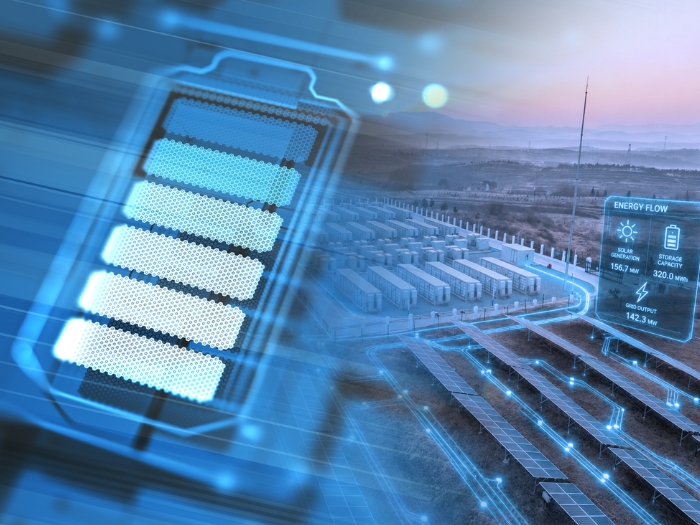
The Australian Energy Market Operator’s (AEMO’s) latest Quarterly Energy Dynamics (QED) report shows record renewable energy output and growing battery participation helped lower wholesale electricity prices in the National Electricity Market (NEM) to their lowest June quarter average since 2020.
According to the report, published on 28 July, renewables hit a record 42.1% of generation, up from 37.1% in Q2 2025. This was driven by strong year-on-year output growth in wind (+20%), grid-scale solar (+12%) and rooftop solar (+6.9%). Coal generation fell 5%, while gas-powered generation dropped 30% to its lowest Q2 average since 2003.
During the quarter in the NEM, 14 new generation and storage projects totalling 3.9GW were commissioned and household battery capacity grew by 3,283MWh (+41%). Grid-scale battery capacity more than doubled over the past year to exceed 9GW. The increasing role of grid-scale batteries also changed price-setting outcomes, with battery charging and discharging setting prices in 36% of dispatch intervals, up from 17% in Q2 2025. All mainland NEM regions recorded a greater influence of batteries on price-setting, particularly New South Wales and Queensland.
Average NEM wholesale electricity prices fell 47% year-on-year to $74 per MWh. Victoria recorded the largest decline, with prices falling 60% to $56/MWh, followed by New South Wales (down 53% to $75/MWh), Queensland (down 44% to $67/MWh), Tasmania (down 39% to $86/MWh) and South Australia (down 38% to $86/MWh).
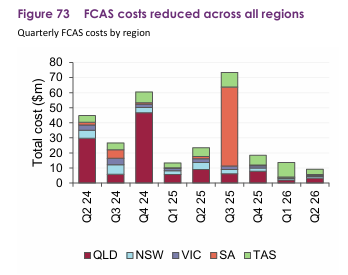
In Q2 2026, total Frequency Control Ancillary Services (FCAS) costs were $9.2M. Compared to Q2 2025, total FCAS costs decreased by $14M (-61%), with reduced costs across all regions. The reduction in costs was spread across regulation services and most contingency services. Batteries remained the dominant providers of FCAS, increasing from 54% in Q2 2025 to 68% this quarter.
Source: AEMO
By the end of June, 17 proposed data centre projects, representing a combined maximum connection capacity of 9GW, were progressing through the connection process. Over half of this capacity was in New South Wales (52%), with Victoria (31%) and South Australia (17%) accounting for the remainder.
Latest energy insights
-
15 October 2026
6 minute read
Following the forecast: the hidden risk in battery optimization | Q&A
Read More -
7 October 2026
4 minute read
Private wires in Ireland: a new route to power for data centres and industry?
Read More -
7 October 2026
7 minute read
What is a distributed energy network, and why are businesses building their operations around one?
Read More -
25 September 2026
3 minute read
The age of electricity: the growing role of electricity in economies and energy systems
Read More -
 Awards
News
Awards
News
17 September 2026
2 minute read
GridBeyond named a Business Energy Achievement Awards winner for innovation in data centre energy flexibility
Read More -

17 September 2026
2 minute read
MPs call for removal of “net zero” from government terminology
Read More