News
better business decisions
Posted 1 month ago | 11 minute read

Solving grid connection challenges with battery solutions
EV fleet adoption in the UK faces a major hurdle. Constraints such as limited distribution network operator (DNO) capacity, delays in grid connections, infrastructure reinforcement costs, and peak demand penalties threaten to inflate timelines and budgets, threatening EV deployment and operational efficiency.
Battery energy storage systems (BESS) offer a solution. By storing off-peak energy or integrating with renewables, batteries can reduce peak load demand and alleviate pressure on constrained grids. This enables faster, more resilient EV charger rollouts without waiting for costly grid upgrades.
In this white paper we explore how batteries can alleviate these issues by reducing peak demand, enabling off-peak charging, supporting demand side response (DSR), and facilitating integration with renewables.
Introduction
EV fleets are expanding at a fast pace in several of the world’s largest markets. This is being driven by governments and automakers who are promoting electricity powered vehicles as a key technology to curb oil use, fight climate change and air pollution. With significant potential to mitigate emissions and decarbonise energy supply chains, electrification is an important strategy to reach net zero goals.
In its latest Global EV Outlook, the IEA noted that Electric car sales exceeded 17M globally in 2024, reaching a sales share of more than 20%. Just the additional 3.5M electric cars sold in 2024 compared with the previous year is more than the total number of electric cars sold worldwide in 2020. Electric car sales in 2025 are expected to exceed 20M worldwide to represent more than one-quarter of cars sold worldwide.
Fleets that are part of the Climate Group’s global EV100 initiative are collectively operating 630,000 electric vehicles (EVs) – a 57% year-on-year increase. The EV100 initiative aims to drive the demand for EVs by getting some of the biggest fleet owners in the world to commit to the transition and to-date, members have committed to run 5.45M EVs by 2030. In its latest progress report, published in April 2024, the initiative noted that, in 2023, 231,000 vehicles were switched to electric by 128 EV100 members. The report also reveals that EV100 fleets have installed more than 35,000 EV chargers at 3,442 different locations, with 5,000 coming online in the last year alone.
According to the Society of Motor Manufacturers & Traders (SMMT), commercial vehicles make up 14% of all vehicles on the road, but their higher mileages and energy demands make them responsible for more than a third of all road transport CO2 and almost an eighth (12%) of the UK’s carbon footprint. Switching to zero-emission vehicles could reduce the UK’s carbon footprint by 35.7megatonnes. But fleet managers, particularly those overseeing heavy vehicles, are struggling to transition due to grid infrastructure and connections planning. SMMT said that companies currently face wait times of up 15 years for grid connections.
Switching to zero-emission vehicles could reduce the UK’s carbon footprint by 35.7megatonnes. But fleet managers, particularly those overseeing heavy vehicles, are struggling to transition due to poor grid infrastructure and connections planning.
Connection pathway
Over recent years connections to the electricity grid have increasingly become a barrier to the deployment of EV charging infrastructure. More generally, the electricity network needs to be transformed at an unprecedented scale and pace to accommodate new low carbon generation and increasing demand, including that arising from EV charging. Charge point operators (CPOs) need to navigate the grid connections process for installing EV infrastructure.
The starting point for any EV infrastructure deployment is an accurate assessment of the existing electricity usage. A thorough understanding of consumption patterns, including total energy use and the timing of peak loads, is critical to estimating the additional demand introduced by EV charging. This assessment should include a determination of the site’s maximum demand, which represents the highest level of power drawn at any one time. This serves as a benchmark for evaluating whether the current connection capacity is sufficient or whether reinforcement will be required. Consumption data can often be obtained from a smart meter, if installed, or by liaising directly with your electricity supplier.
The scale of the installation will influence which type of connection partner is appropriate:
- Distribution network operators (DNOs): these are the primary electricity distributors in your region and often the first point of contact for standard commercial or industrial connections. A postcode search can help identify the relevant DNO.
- National transmission system operator: for large-scale EV charging installations, such as fleet depots or public charging hubs, a direct connection to the National Electricity Transmission System (NETS) may be required.
- Independent distribution network operators (IDNOs): these licensed operators generally supply new housing and commercial developments. IDNOs are responsible for managing and operating the networks they develop.
Early engagement with your connection partner is essential. The chosen provider will conduct a detailed feasibility assessment and collaborate with you through every phase of the connection process.
It is also necessary to define the number, type, and usage pattern of EV chargers to be installed. Each of these variables will influence the load profile and the required capacity of the site.
- type of vehicles and charging times: the size and nature of the batteries to be charged will significantly impact load requirements. Sharing this information with the DNO can enable a more efficient connection design, potentially avoiding unnecessary infrastructure upgrades.
- number of chargers and load management: the total number of vehicles to be serviced does not always dictate the number of chargers needed. Chargers can be rotated between vehicles, or load management systems can be installed to control simultaneous charging based on available capacity.
- duration and timing of charging: the length of time a vehicle is connected to a charger and the battery’s state of charge upon arrival affect the power draw over time. Efficient scheduling and demand smoothing techniques can prevent overloads and maximise use of existing infrastructure.
- smart charging capabilities: where grid constraints exist, DNOs may offer flexible or smart connection options. These connections can include conditions such as time-of-day restrictions, usage caps, or the installation of real-time monitoring equipment. Smart charging systems dynamically adjust the rate of charge based on grid load, site consumption, or tariffs, making them particularly suitable for sites with variable demand or limited connection capacity.
Strategic demand management
There are several strategies available to optimise the use of grid capacity and reduce the costs associated with new EV charging installations.
An essential strategy in preparing sites for EV charging infrastructure is the intelligent management of electrical demand.
One of the most straightforward approaches is the optimisation of existing electrical loads. This involves adjusting the way power is consumed across a site, particularly during peak hours when energy use is typically highest. By identifying flexible or non-critical loads (such as heating, ventilation, and air conditioning (HVAC) systems, or heavy machinery) site managers can schedule operations in a way that reduces power draw during periods when EVs are expected to charge. For example, reducing HVAC output during a scheduled charging window or shifting industrial processes to off-peak hours can free up capacity, allowing more vehicles to be charged without increasing the site’s total demand on the grid.
Complementing this strategy are load management systems, which provide a solution to balancing electrical usage. These systems use intelligent software to control the distribution of power to EV chargers based on real-time load data. Rather than all chargers operating at full capacity simultaneously, the system ensures that total demand remains within the maximum import limit by dynamically adjusting charging speeds. While this may result in slower charging during high-demand periods, it significantly enhances overall efficiency and can eliminate the need for infrastructure reinforcement. Sites can also formalise their charging activity with the grid operator, stipulating that EV charging will occur only during designated off-peak hours.
By adhering to the agreed schedule, site operators may be able to bypass the need for connection upgrades, thereby reducing both capital expenditure and project lead times. This model is especially well-suited to commercial fleets or public transport operators with predictable charging windows.
Rather than immediately pursuing expensive grid upgrades, site operators are increasingly exploring methods to optimise their current power usage, leveraging technologies and operational strategies to accommodate EV charging within their existing capacity.
Future-proofing your fleet
Another way to manage power demand is the incorporation of on-site generation and battery storage systems.
By installing renewable energy technologies such as solar photovoltaic (PV), sites can produce their own electricity and store any surplus in stationary batteries. This stored energy can then be used to charge EVs, either during periods of high demand or when grid electricity is more expensive or less available.
In some configurations, battery systems can also act as demand response assets, discharging strategically during peak periods. The integration of battery storage not only enhances energy resilience and flexibility but also aligns with broader sustainability goals by supporting the use of clean energy for transportation.
Battery energy storage systems store electrical energy in chemical batteries for later discharge. BESS units range from small kilowatt-hour (kWh) systems supporting a single charger, to multi-megawatt-hour (MWh) systems powering entire depots.
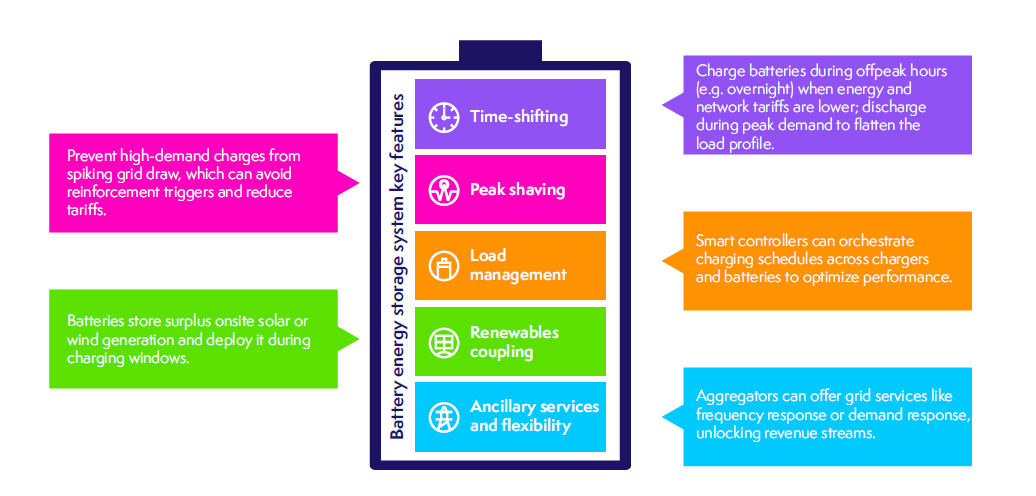
Together, demand optimisation combined with on-site generation and battery storage enable businesses to integrate EV charging infrastructure in a cost-effective and future-ready manner.
Revenue opportunities
For grid operators, the first priority for accommodating electric vehicles in the power grid has been ensuring there will be enough electricity to fill them without causing blackouts elsewhere. But as EVs become more capable and start making up more and more of the market, there is increasing potential that EVs could also feed power back onto the grid during times of high demand, easing the need for new power plants and all they entail and presenting a revenue generating opportunity for fleet owners.
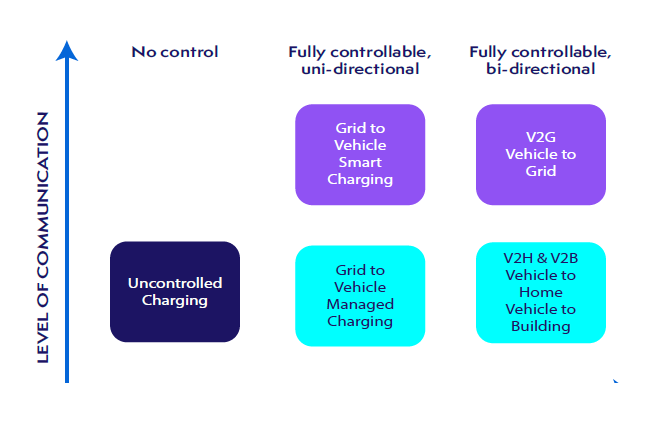
There are two main ways that EVs can be used to support the grid. The first and simplest way is through smart charging but a better way is through Vehicle to Grid (V2G) optimisation.
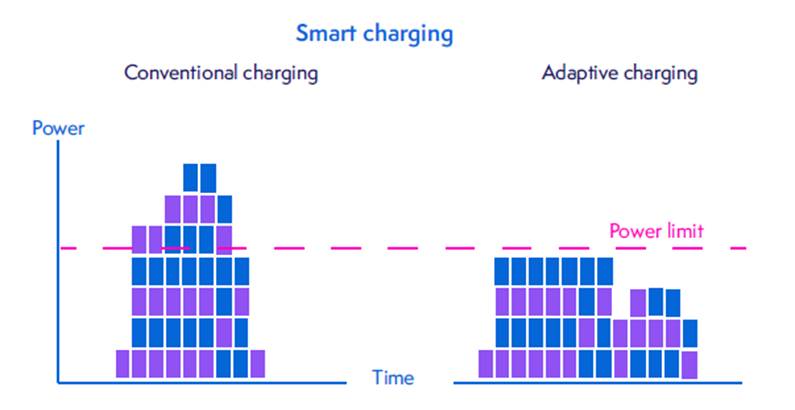
Smart (also known as managed or intelligent) charging is where an EV is charged in a way that spreads the load across a specific time scale. This is made possible through a system where an EV and a charging device share a data connection with a charging operator. It essentially allows the charging station owner to monitor real-time data such as supply and demand on the local electricity network and to manage the use of their devices remotely to optimise charging of the EV.
Consumers can benefit from cheaper power, and operators benefit from an easier to balance system by avoiding all cars being charged simultaneously. Smart meters have the potential to allow more detailed information on consumption to be sent to energy suppliers and more reactive use of power for customers.
An extension of smart charging, the concept of V2X. V2X is the overall term for different forms of bi-directional charging and discharging of the EV battery, including vehicle-to-grid (V2G), vehicle-to-building (V2H), and vehicle-to-load (V2L).
V2X systems use a combination of hardware and software, including vehicle controllers, inverters, and communication protocols, to enable the bi-directional flow of power and data between EVs and external systems. This mechanism permits the grid to draw on EVs’ stored energy to accommodate sudden surges in power requirements. The EV battery power is then replenished when the demand on the system is low.
One major benefit of V2X technology is its potential to stabilise the grid by providing additional flexibility and balancing services to better manage peak demand periods and reduce the need for peaker plants and thus allow for the integration of more renewable energy sources.
For end users, V2X technology can provide an additional revenue stream. EV owners can sell the stored energy in their vehicle’s battery back to the grid during peak demand periods, earning credits or cash payments. This can help offset the cost of owning an EV and reduce the total cost of ownership.
Conclusion
Securing timely, scalable grid connections remains one of the prime obstacles to widespread EV fleet adoption in the UK. By incorporating a battery-backed charging infrastructure today, UK EV fleet managers can avoid the bottlenecks of traditional grid dependency, unlock cost efficiencies, and stand at the forefront of fleet decarbonisation. For forward thinking fleet managers, integrating BESS into EV infrastructure it is a strategic differentiator that deliver strategic and financial advantages for EV businesses.
Latest energy insights
-

20 October 2026
6 minute read
Choosing a demand response or battery optimisation partner: 10 questions to ask before you sign
Read More -
15 October 2026
6 minute read
Following the forecast: the hidden risk in battery optimization | Q&A
Read More -
7 October 2026
4 minute read
Private wires in Ireland: a new route to power for data centres and industry?
Read More -

7 October 2026
7 minute read
What is a distributed energy network, and why are businesses building their operations around one?
Read More -
25 September 2026
3 minute read
The age of electricity: the growing role of electricity in economies and energy systems
Read More