News
better business decisions
Posted 1 week ago | 5 minute read
EirGrid’s Winter Outlook shows improved adequacy forecast
The power system will operate well within the level of risk that is set by the Department of Climate, Energy and the Environment this Winter, EirGrid’s Winter Outlook 2026-27 has shown.
Published on 19 October, the document shows an improved outlook for the winter ahead. The risk of insufficient generation being available to meet demand is lower than it has been in recent years, reflecting the positive impact of additional generation and battery storage capacity that has come onto the system, along with out of market measures strengthening Ireland’s overall security of electricity supply.
The generation adequacy situation has improved for a number of reasons, including new sources of generation on the system in the form of 275MW of new gas fired peaker plants and 63MW of new batteries delivered through the Capacity Market, as well as the addition of an extra 809MW of wind and solar generation. Other factors include interconnection and the continued implementation of the Security of Supply Programme which is led by the Commission for Regulation of Utilities (CRU).
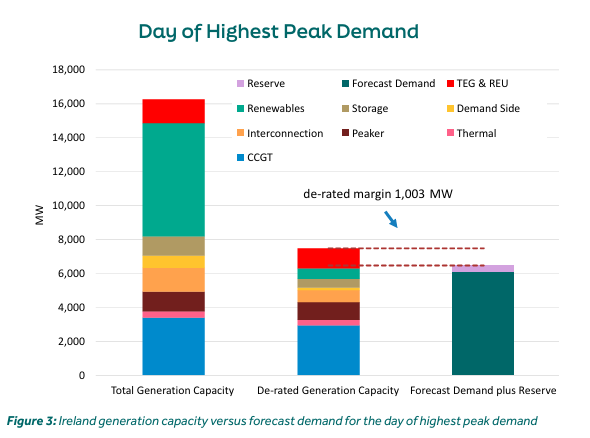
Source: EirGrid
The analysis forecasts the Loss of Load Expectation (LOLE) in Ireland for the five months of the winter period is 0.8 hours, which is inside the 3-hour annual LOLE Standard set for Ireland. The LOLE for this winter is down from 1.1 hours last winter, 3.6 hours the winter before that and 21 hours the winter before. If Temporary Emergency Generation (TEG) and Retained Existing Units (REU) are excluded the LOLE becomes 40.6 hours.
The minimum de-rated margin over the winter period is expected to be in the range of 920MW to 1,070MW. The system may enter the Alert (Amber) State at times, most likely at periods of low wind and low interconnector imports. But there is a low probability of the system entering the Emergency (Red) State, due to insufficient generation being available to meet the demand.
The peak demand for electricity last winter of 5,916MW was recorded on 5 January 2026, below EirGrid’s median forecast peak of 6,044MW. For Winter Outlook 2026-27, the median forecast peak demand is 6,101MW.
Frequently asked questions
Is Ireland’s electricity supply secure this winter?
Broadly, yes. EirGrid puts the LOLE for the five-month winter period at 0.8 hours, comfortably inside the three-hour standard. That’s an improvement on last winter’s 1.1 hours and 3.6 hours the year before.
How high is demand expected to go?
EirGrid’s median forecast for peak demand is 6,101MW, up from last winter’s recorded peak of 5,916 MW. Peak demand has been climbing steadily for several years, and the weather plays a big part: every 1°C drop in temperature adds roughly 55MW to the peak.
What new capacity has come onto the system?
The assessment includes 275MW of new gas-fired peaking plant and 63MW of new batteries, both delivered through the Capacity Market, plus 809MW of new wind and solar that connected over the past year.
How much does the outlook rely on emergency measures?
Quite heavily. The analysis counts 649 MW of temporary emergency generation and 750 MW from the retained Moneypoint units. Without them, LOLE would jump to 40.6 hours, above the standard, and the minimum de-rated margin would fall from 1,003MW (15.5%) to a deficit of 178MW (-2.8%).
Key terms
- loss of load expectation (LOLE): a statistical estimate of how many hours over a given period there may not be enough available generation to meet demand at that moment. The higher the figure, the greater the risk of a shortfall.
- LOLE standard: the maximum level of risk the Department of Climate, Energy and the Environment (DCEE) considers acceptable for the system. In Ireland, it’s three hours a year.
- Alert State: a situation where one further event on the power system could reasonably push it past an operational security limit, such as being unable to meet demand.
- Emergency State: a situation where one or more operational security limits have been breached.
- de-rated margin: the total de-rated capacity from all available generators and interconnectors, minus forecast demand and the reserve requirement. A positive figure points to sufficient capacity; a negative one suggests a possible shortfall.
- Reserve requirement: extra generation that needs to be on hand in case expected supply is disrupted.
- Demand side unit (DSU): one or more customer sites that the system operator can call on to cut their electricity use.
- Temporary emergency generation (TEG): generation that EirGrid has procured and runs as a last resort. It’s only used when the system would otherwise slip into an Alert or Emergency State and market measures alone can’t stop things getting worse.
- Retained existing units (REU): Moneypoint units MP1, MP2 and MP3, kept available to support security of supply. Like TEG, they are only dispatched when market measures are not enough.
- Interconnectors: links between electricity systems. This outlook covers the East West Interconnector (EWIC) and Greenlink (500MW each, both to Great Britain) and the North-South Tie Lines connecting Ireland and Northern Ireland.
Latest energy insights
-
26 October 2026
4 minute read
Britain’s electricity supplies expected to remain secure this winter
Read More -

20 October 2026
6 minute read
Choosing a demand response or battery optimisation partner: 10 questions to ask before you sign
Read More -
15 October 2026
6 minute read
Following the forecast: the hidden risk in battery optimization | Q&A
Read More