News
better business decisions
Posted 1 month ago | 5 minute read

Great Britain: flexibility market guide
Great Britain runs one of the most open flexibility markets in the world. NESO (the National Energy System Operator) buys balancing and frequency services nationally, the six DNOs buy local flexibility, and wholesale trading happens on day-ahead and intraday exchanges.
For industrial sites and batteries, that means plenty of opportunities to make revenues from energy flexibility. In this guide we take a look at the options available.
Markets
For distributed assets, value tends to sit in a few places:
- wholesale and imbalance optimisation: shifting consumption or charging into cheaper half-hours, and exporting or discharging into expensive ones. It’s open to aggregators with a Virtual Trade Party (VTP) qualification
- the Capacity Market: an annual availability payment, secured at T-4 and T-1 auctions, for being on hand when the system is tight
- NESO reserve and the Demand Flexibility Service: slower, minutes-scale services
- local network flexibility: distribution network operator (DNO) tenders that pay sites in a specific area to reduce demand (or increase generation) when a substation is under pressure. Some DNO flex opportunities also go in the reverse direction i.e., paying for increased consumption or reduced generation
- frequency response (Dynamic Containment, Dynamic Moderation and Dynamic Regulation) need full delivery in one to 10 seconds, which suits batteries well but rules out most industrial load. Static Firm Frequency Response, with a 30-second response, is still procured and remains a realistic option for some load assets
- Slow Reserve replaced Short Term Operating Reserve (STOR) on 31 March, and Quick Reserve has replaced Optional Fast Reserve. Both are open to non-BM units from 1MW, which widens access for aggregated sites
- the Balancing Mechanism (BM) is NESO’s core real-time market. It’s open to aggregators through the Virtual Lead Party route, with units from 1MW, but registration and dispatch requirements are heavier than for most other services. Batteries are now the main participants
Products
The table below covers the GB services most relevant to industrial load and battery storage. Technical figures are NESO’s, Ofgem’s or the relevant DNO’s; the fit ratings are GridBeyond’s view of how well each service suits the asset type.
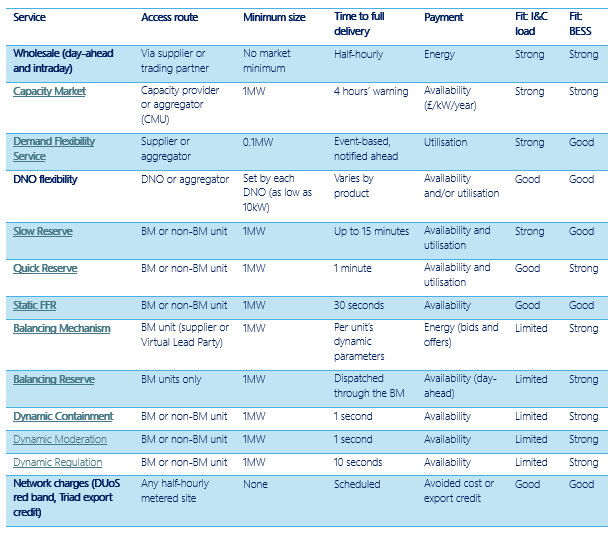
Since April 2023 the transmission demand residual has been a fixed £/site/day charge, so avoiding Triads no longer cuts that part of the bill. Exporting embedded generation and batteries can still earn the Embedded Export Tariff over the three Triad periods.
How GridBeyond works
True value for businesses comes from stacking: earning a Capacity Market payment, sitting in reserve or DFS when the price is right, and trading the rest of the time, without ever double-committing the same megawatt.
That’s what GridBeyond’s AI-powered Point platform does. It connects site assets (process load, CHP, on-site generation, batteries and EV charging) and forecasts prices, consumption and grid signals to decide, half-hour by half-hour, where each asset earns most. Sites set their own operating limits, so production always comes first.
- for energy users: Demand Side Response with no up-front cost. GridBeyond installs and monitors the hardware and software and takes a share of the revenue. More than 500 sites across the UK and Ireland already work this way.
- for battery owners: route-to-market and AI-driven optimisation across wholesale trading, NESO services and the Capacity Market.
- for both: one platform and one team handling forecasting, bidding, dispatch and settlement across every market in the table above that suits the asset.
Upcoming changes
The direction of travel is for services to evolve with lower participation thresholds, more services open to non-BM assets, and more value for flexibility that can turn up as well as down.
- DFS is now year-round and two-way: Ofgem approved the redesign in March 2026. The service now pays for turn-up as well as turn-down, offers self-nominated baselines for non-domestic sites, and has a lower 0.1MW threshold. NESO is also moving constraint management from the Local Constraints Market into DFS, starting with selected Scottish constraints from 7 October 2026
- Market-wide half-hourly settlement lands in May 2027: Elexon expects over 80% of meters to be migrated by the end of 2026. That unlocks more granular, price-responsive tariffs and makes smaller sites easier to aggregate
- Reserve reform is bedding in: Slow Reserve and Quick Reserve are live, and non-BM services have moved onto NESO’s Open Balancing Platform. Expect further tweaks to service terms as NESO reviews the initial data
- Dynamic Response rules are still being refined: Some proposed changes went live on 31 July 2026; NESO expects to reconsult on others in the near future
- consultation on locational procurement: for both response and reserve services. This consultation is expected but the commercial implication is that location could increasingly affect procurement and revenue opportunities
- Capacity Market reform: a consultation recently closed on prequalification 2027, which introduced significant shifts in delivery assurance and consumer-led flexibility, specifically targeting how Demand Side Response (DSR) is evaluated and tested. This could materially affect the capacity and revenue that industrial flexibility can secure
Latest energy insights
-

11 November 2026
5 minute read
Connection is the new location: what the Data Centre Covenant means for power and flexibility
Read More -

26 October 2026
4 minute read
Britain’s electricity supplies expected to remain secure this winter
Read More -

20 October 2026
6 minute read
Choosing a demand response or battery optimisation partner: 10 questions to ask before you sign
Read More -
15 October 2026
6 minute read
Following the forecast: the hidden risk in battery optimization | Q&A
Read More