News
better business decisions
Posted 1 month ago | 8 minute read

Solar + batteries: guide for social housing, commercial and retail parks and campuses
Most solar battery guides are written for one homeowner, one roof and one bill. That’s a useful conversation, but it isn’t the one facing a housing association with 4,000 homes, a developer trying to get 300 plots connected to a congested substation, or a retail park owner whose tenants are asking for EV charging the grid can’t yet supply. At that scale, a battery becomes an asset that can cut bills, earn revenue, ease grid constraints and strengthen your net zero case. The trick is getting the design, the commercial model and the software right.
The short version
Solar on its own saves money in daylight. Storage lets you use that energy later, buy cheaper power off-peak and sell flexibility back to the grid when it’s needed most. For a single house, the last of those is marginal. For hundreds of homes or a multi-megawatt retail site, it can be the difference between a battery that just about pays its way and one that earns its keep.
Social housing: lower bills for tenants
Many housing providers have already put solar on their stock, often through government programmes such as the Warm Homes: Social Housing Fund. The problem is that tenants frequently aren’t home when the panels are generating, so a lot of that value is exported for pennies and bought back in the evening at full price. Adding storage closes that gap. But the bigger opportunity lies in treating the portfolio as a whole.
Individually, a few kWh in each home doesn’t move a market but (when aggregated and centrally optimised( hundreds of batteries act as a single flexible resource that network operators increasingly want. Research by Oxera suggested that targeted battery deployment in social housing could supply up to 77% of the extra local grid capacity the UK will need by 2035, alongside around £220 a year in bill savings for those households. In June 2026, the government’s call for evidence on community batteries set out several models, including a shared battery wired behind each resident’s meter in a block of flats, which can give residents direct bill savings and a share of export revenue without forcing them onto a particular supplier or contract.
Residential developers: route to connection
For developers, the headline problem often is often getting connected. Network capacity is tight and a scheme can be viable on paper but stuck in the queue.
Storage changes the load profile a development presents to the grid. By flattening peaks, especially from heat pumps and EV chargers arriving together at the evening peak, it can reduce the capacity you need to ask for. The government’s own consultation notes that community batteries could help new residential developments connect in constrained parts of the network more quickly, potentially enabling faster housing growth. Individual home batteries, a shared site battery behind a landlord meter feeding a microgrid, or a hybrid of both will each suit different tenures, layouts and ownership structures. It can be far cheaper to settle this at planning stage than to retrofit.
Campuses: cut peak costs
Retail parks and shopping centres combine several things storage is good at. Large roof space and on site loads such as refrigeration, HVAC and lighting, which creates predictable demand. But EV charging hubs are adding sharp, costly peaks that the existing connection often can’t absorb.
A battery sized for the site can shave those peaks during the most expensive network periods, let rapid chargers run without an immediate connection upgrade, and provide backup for critical loads. Refrigeration adds another layer of flexibility as chillers and cold rooms can shift their demand by minutes without affecting stock, which makes them valuable assets in their own right.
Where the value comes from
It helps to separate the ways a battery makes or saves money. They stack, but they don’t all apply to every site.
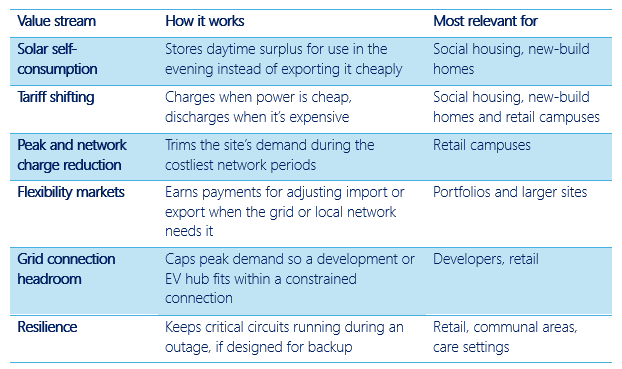
One point that often gets lost: a battery’s financial case isn’t simply “electricity you didn’t buy”. The question is whether the combined value of the various streams is greater than the cost of the asset over its working life. That’s a modelling problem, and it’s where optimisation software is key.
The specs that matter most
Datasheets for commercial and multi-home energy storage throw up the same numbers as domestic ones, but the consequences of misreading them are bigger.
- usable capacity, not nameplate: manufacturers hold back a reserve to protect the cells. Compare the energy you can actually cycle
- power as well as energy: a battery’s kWh tells you how much it holds; its kW tells you how fast it can deliver. Flexibility markets and peak-shaving often reward power, so a unit with plenty of capacity but a modest inverter can leave value on the table
- round-trip efficiency: losses compound across thousands of cycles. A few percentage points matter over ten years
- warranty conditions: many warranties cap cycles or total energy throughput. If you plan to actively trade flexibility, check the warranty permits it, and that your optimiser is set up to respect those limits rather than chase every spread
How GridBeyond can help
Whatever the setting, GridBeyond’s technology co-ordinates batteries, flexible demand and on-site generation in one optimiser, and it aggregates dispersed assets into a virtual power plant so they can reach flexibility revenue no single property could on its own.
For housing providers, that means one platform for the whole estate, with the tenant’s interests built in from the start. Our AI prioritises bill savings and the long-term health of their battery, and it only trades capacity that’s genuinely spare. This is supported by clear reporting on savings, carbon and revenue.
For residential developers, GridBeyond models demand across the whole scheme to size storage that keeps the development inside its connection agreement. Our forecasting is built for how electrified buildings actually behave, with heat pumps and EV chargers all pulling power at once. Once homes are occupied, the same assets can be optimised for savings and flexibility income. That’s a selling point for buyers and a potential ongoing revenue for whoever manages the estate.
For retail campuses, the biggest barrier is often capital, and we can remove it. GridBeyond offers battery storage with no up-front cost, so owners and landlords can secure resilience and lower energy bills without tying up money they’d rather spend elsewhere. We already work with some of the biggest names in retail, helping them take part in energy markets without customers ever noticing a difference in store.
Conclusion
For a single household, the case for storage usually rests on self-consumption and a time-of-use tariff, and it can be marginal. At portfolio or campus scale, three things shift in your favour:
- access to markets: flexibility services have minimum sizes and technical requirements that only aggregated or larger assets can meet
- better optimisation: forecasting generation, demand and prices across many assets together lets software make smarter decisions than a timer on a single battery ever could
- procurement leverage and consistent specification across a programme
Whoever you work with, a credible proposal should answer these clearly: the usable capacity and power of each unit; the round-trip efficiency and the conditions behind it; the warranty’s cycle or throughput limits and whether market trading is permitted; the assumptions behind any savings or revenue forecast, including import, export and market prices; how the assets will be controlled, monitored and reported on; who owns the revenue and how it’s shared between landlord, tenant or occupier; and what backup the system provides, for which circuits, at what power. If a forecast doesn’t separate avoided costs from lost export income, or treats every revenue stream as guaranteed, push back.
Frequently asked questions
Is battery storage worth it for social housing?
It can be, particularly where homes already have solar and tenants use most of their electricity in the evening. The case strengthens considerably when batteries are aggregated and optimised as a portfolio, opening up flexibility revenue that single homes can’t reach.
Can a battery help a housing development get a grid connection?
Yes, in many cases. By limiting peak demand, storage can reduce the connection capacity a scheme needs. It should be designed in early, alongside heating and EV charging plans.
What does a battery do for a retail park?
It can reduce costs during expensive peak periods, support EV charging within an existing connection, back up critical loads and earn revenue from flexibility markets.
What is a virtual power plant?
A virtual power plant (VPP) links many distributed assets, such as home batteries, commercial storage and flexible loads, and controls them as a single resource that can respond to grid and market signals.
Talk to us
GridBeyond manages more than 1,400 client sites and over 800MW of battery storage, with 24/7 monitoring from our network operations centre. Whether you’re managing a housing portfolio, planning a development or running a retail campus, we can show you what your assets could be worth.
Latest energy insights
-
26 October 2026
4 minute read
Britain’s electricity supplies expected to remain secure this winter
Read More -

20 October 2026
6 minute read
Choosing a demand response or battery optimisation partner: 10 questions to ask before you sign
Read More -
15 October 2026
6 minute read
Following the forecast: the hidden risk in battery optimization | Q&A
Read More